
Superfog: State of the Science
Alan Long, Joshua Weiss, Marko Princevac, Christian Bartolome
Publication ID: Fact Sheet 2014-2 Published: 2014 Revised: 2021, 2026
(View PDF)
Introduction
Superfog is a very dense fog with visibility less than 10 feet and often less than 3 feet. It is the extreme condition of increased fog density associated with specific atmospheric and weather conditions. In the Southeast, superfog events have resulted in multiple tragic motor vehicle accidents on major travel corridors, and these events are almost always associated with smoke. Thus, predicting superfog is critically important for wildland fire managers, especially for smoke management concerns in prescribed burn planning. The International Association of Wildland Fire Smoke Symposium in October 2013, featured several presentations on the current “state of the science” for superfog prediction. This fact sheet summarizes those presentations in order to familiarize burn anagers with the tools and information they can use to prepare for and determine the likelihood of superfog events. The smoke symposium presentation recordings will be available on the Smoke Symposium website through the virtual registration option until October 2014, available at http://www.iawfonline.org/wp-content/uploads/2018/02/2013SmokeSymposiumProceedings-Final.pdf.
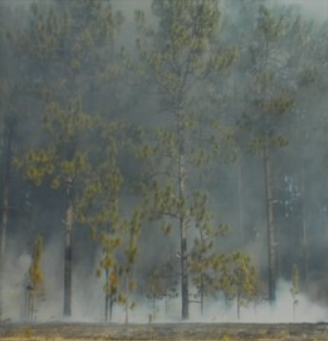
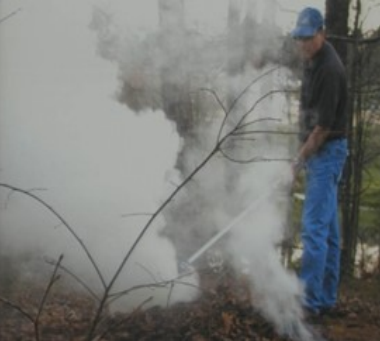
Superfog is the very dense white smoke along the ground under the tree stand in the left photo, and above the pile on the left side of the right photo. Note that in both photos nothing (tree stems, for example) is visible behind the super fog. Photos from Gary Achtemeier’s presentation at the 2013 IAWF Smoke Symposium.
Box 1: Favorable Atmospheric Conditions for Smoke-Induced Fog
- Surface air temperature less than 70°F
- Relative humidity greater than 90%
- Surface wind speed less than 7 mph
- Cloud cover less than 60%, with critical levels less than 40%
- Atmospheric Dispersion Index (ADI) less than 10
- Low Visibility Occurrence Risk Index (LVORI) 7 or higher
- Turner Stability Index values of E, F, G (stable to very stable surface layer)
What Causes Superfog?
Considerable water vapor, usually appearing as white smoke, is emitted from the smoldering combustion of moist fuels such as organic soil, duff, and logs. When water vapor mixes with cold air under the right temperature and relative humidity conditions, the cold air becomes saturated and fog forms. This is the same process that leads to dew or fog formation when air without smoke cools to the dew point temperature. When particulate matter from smoldering fuels provides additional condensation nuclei for the water vapor in the smoke, the resulting small droplets scatter light and reduce visibility even more effectively than regular fog. The cool air mixed with smoldering smoke can result in supersaturation and the formation of very dense fog (i.e., superfog). Conditions favorable for smoke dispersion, such as wind and atmospheric instability, generally reduce the likelihood of supersaturation and superfog development.
Smoke Dispersion Matrix
Given this physical process for the development of superfog, it is easy to understand the atmospheric conditions most conducive to superfog: cool, clear, calm nights. Typically, by early morning hours, surface air temperatures are at their lowest, resulting in the greatest temperature differential between still air above the smoldering fire and smoke temperatures. During this time, surface relative humidity is typically highest, perhaps at 100% even without the addition of water vapor and small water droplets from smoke. Researchers Gary Achtemeier and Gary Curcio have identified the following atmospheric conditions as favorable for producing smoke-induced fog and summarized these conditions in a Smoke Dispersion Matrix (Box 1).
Predictions for all of these parameters are available, or can be requested, through National Weather Service (NWS) Fire Weather Forecasts. The possibility of a superfog event is high when all of the conditions in the Smoke Dispersion Matrix are satisfied concurrently near a smoldering fire.
Superfog Index
Box 2: Seven Critical Questions to Ask when Fog Development is Possible
- Do you have a smoldering fire that will burn all night?
- Is there a road within 3 miles?
- Is the wind direction toward the road?
- Do drainages lead from the fire to the road?
- Are temperatures predicted to be less than 50°F?
- Is relative humidity predicted to be above 80%?
- Will the smoldering fire be in moist or organic fuels?
National Weather Service Superfog Smart Tool
Using the critical parameters in the Smoke Dispersion Matrix, Josh Weiss developed a smart tool (algorithm) for use in fire weather forecasts produced by the NWS office in Wilmington, NC, that identifies areas on their forecast maps where all critical values will be met in the next 48 hours, thus suggesting a high probability for superfog. He notes that the program should only serve as a forecast aid and not a decision tool. Using this tool, fire managers can look at the potential fog areas and determine if smoke from their fires may lead to superfog formation. In the future, NWS forecasters may be able to look at the probable fog areas and alert land managers to the threat of superfog development near fires. This program may provide land managers time to modify resources and plans to prepare for or prevent superfog development from prescribed fires.
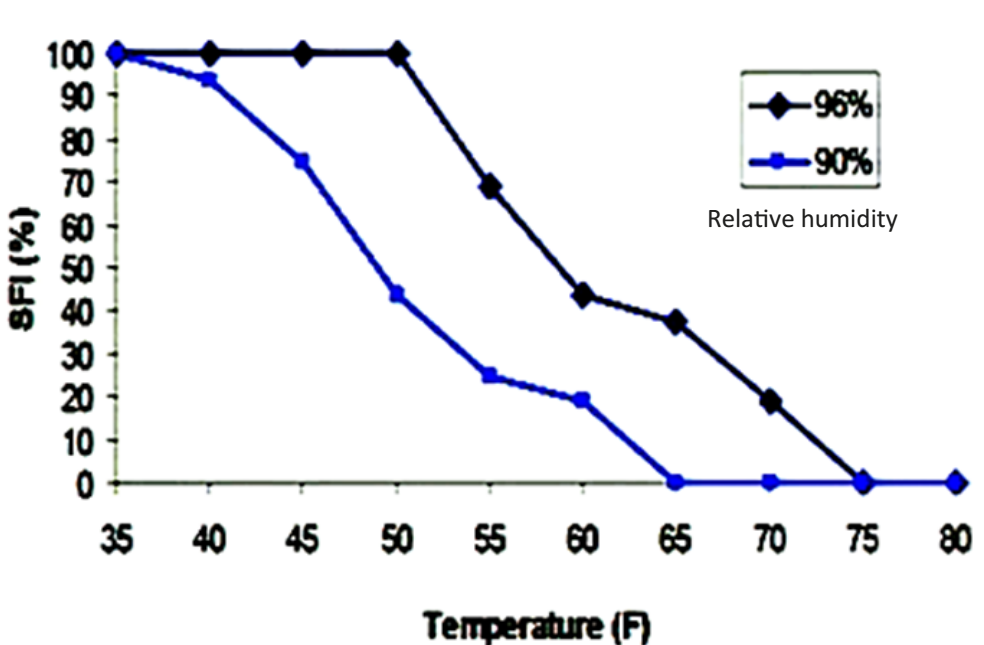
The Weiss NWS superfog smart tool has been further refined to incorporate Achtemeier’s SFI, described previously, with the intent that in the near future the SFI can be displayed graphically and added to Point Fire Weather forecasts. When finalized, the program will be shared with other NWS offices in the Southeast.
Superfog Analysis Model
At the same time that these forecast tools have been developed, the University of California (UC), Riverside has conducted theoretical and lab-based experiments on the development and movement of superfog. Their work, described in a webinar on February 12, 2014 and archived at www.wildfirelessons.net/Resources/advancesinfirepractice/webinars clearly demonstrates that both water vapor and condensation nuclei (such as particulate matter) in smoke are necessary for superfog formation. Their results also suggest the opportunity for further refinement of the following weather and fuel characteristics necessary for superfog formation (Box 3).
Box 3: Superfog Analysis Model Refinements
- Surface air temperatures less than 40°F
- Wind speeds less than 2 mph
- Fuel moisture contests greater than 40%
The UC Riverside researchers have developed the Superfog Analysis Model (SAM) that uses the following inputs to predict the likelihood of superfog forming at a burn site: ambient temperature, relative humidity, atmospheric stability, heat and water vapor produced by a smoldering fuel bed, and fuel bed height. A working version of the SAM superfog prediction tool is described in Appendix B of the Final Project Report to JFSP, available at https://www.firescience.gov/projects/09-1-04-5/project/09-1-04-5_final_report.pdf. Readers are cautioned that SAM, like the NWS Superfog Smart Tool, only predict the likelihood of superfog formation in the vicinity of the fire. Smoke movement away from the fire must be projected with other smoke dispersion tools, such as PB-Piedmont.
What Should Prescribed Burn Managers Watch For?
As the models described above become more widely used in forecasting, burn managers will be able to access superfog probabilities through regular fire weather forecasts. However, whether or not those forecasts are available, the parameters described above (Smoke Dispersion Matrix critical values, critical questions, and SAM critical parameter refinements) should be assessed before prescribed fire ignitions to determine if there is any possibility of superfog formation.
References
- Princevac, Marko, David Weise, Akula Venkatram, Gary Achtemeier, Shankar Mahalingam, Scott Goodrick and Christian Bartolome. 2013. Superfog formation: Laboratory experiments and model development JFSP Project ID: 09-1-04-5, Final Project Report, Joint Fire Science Program.