
Reintroducing Fire Into Long-Unburned Pine Stands: The Duff Problem
1Tall Timbers Research Station, Tallahassee, Florida
Publication ID: Fact Sheet 2018-4 Published: 2018 Revised: 2026
(View PDF)
Introduction
In many areas throughout the South, long-term fire exclusion (one to several decades) has changed pineland communities by allowing thick layers of duff to accumulate. Thick duff layers pose a unique challenge to fire managers wishing to restore natural fire regimes. In this fact sheet, we discuss the risks associated with heavy duff accumulation and present strategies for reintroducing fire to long-unburned pinelands.
What is Duff?
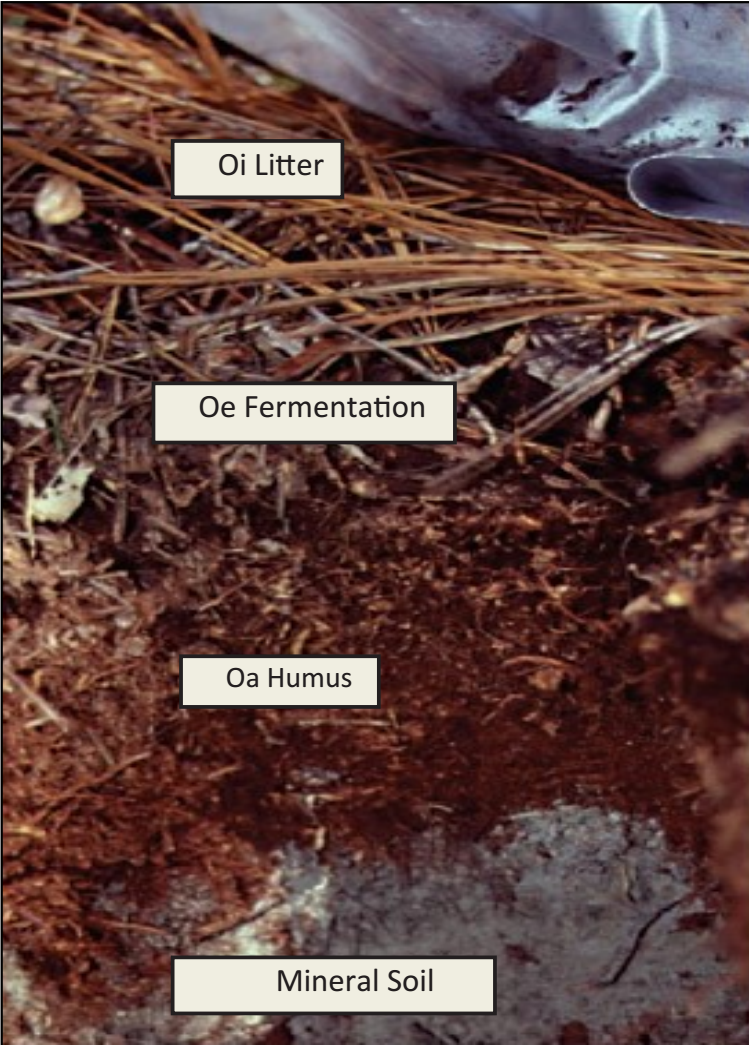
Duff is a layer of partly decayed organic material that accumulates on the forest floor. It lies above the surface mineral layer and below the litter layer (L or Oi horizon). The duff layer can be divided into the upper or shallow duff and lower duff layers. Upper duff includes lightly to moderately decomposed material and can be referred to as the Oe or F (Fermentation) layer. Lower duff is highly decomposed and includes the Oa or H (Humus) layer.
Duff Accumulation
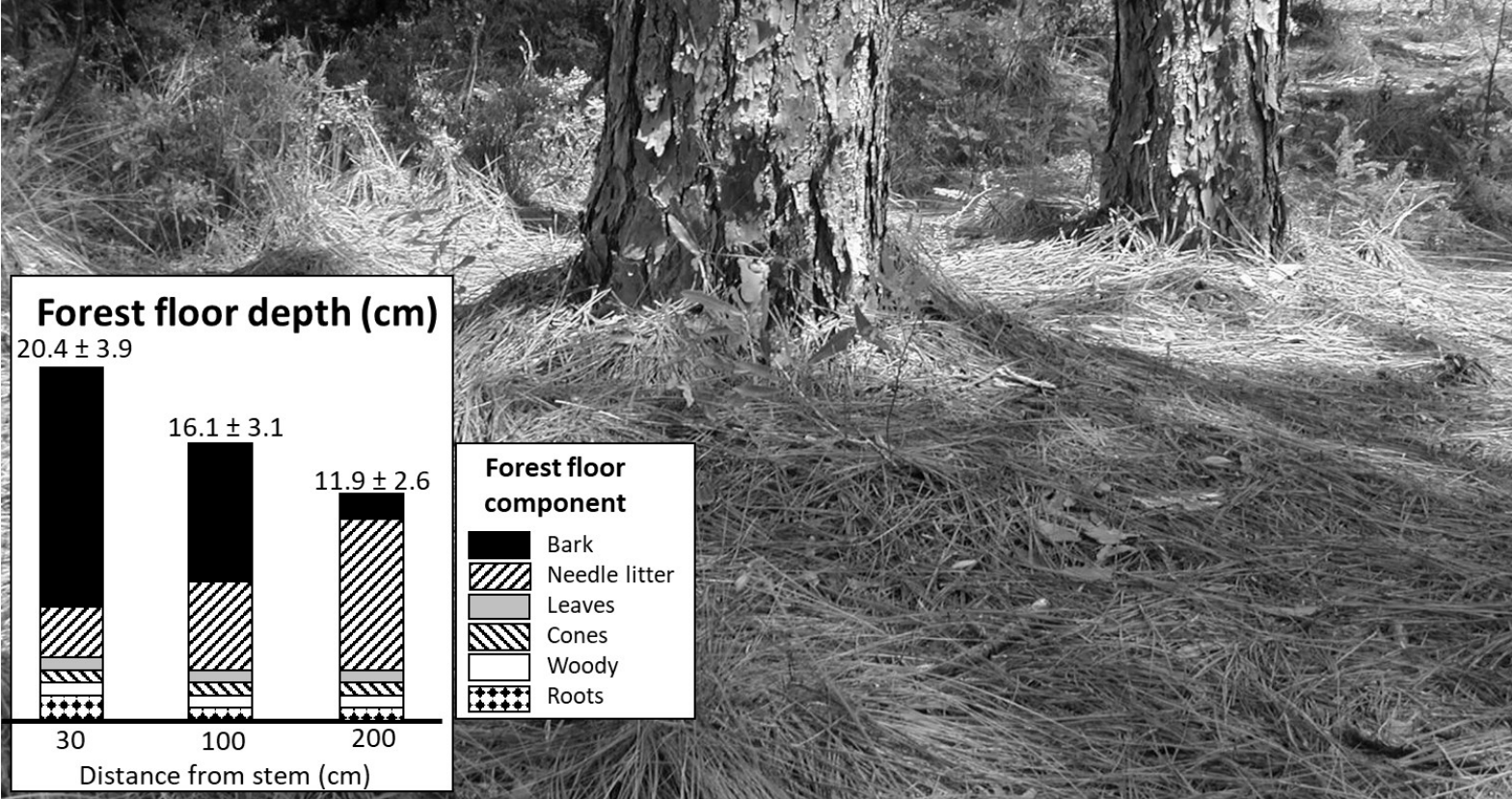
Duff is a soil layer of partly decaying organic material (see box) that includes sloughed bark, leaf litter, pine cones, roots, and woody fuels. In pine communities, the composition of duff varies spatially. Close to the tree, duff includes a significant amount of sloughed bark, while further from the tree duff tends to be composed of mostly pine needles. Duff layers tend to be deepest at the bases of trees, where duff accumulations can exceed 8-12” deep after decades of fire exclusion (Varner et al. 2005; Harrington 2013; Kreye et al. 2014). Pinelands that have been frequently burned (1-3 year fire return intervals) typically have little or no duff accumulation.
Duff Combustion
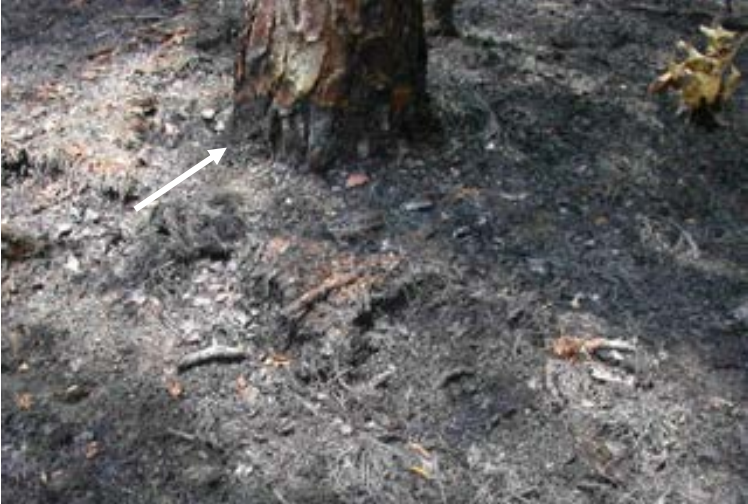
Duff can burn via smoldering combustion, which is a slow, low-intensity, flameless combustion that occurs as oxygen reacts with the surface of fuels. Smoldering fires can persist for long periods of time and can be challenging to detect. With sufficiently low fuel moisture, duff can be ignited directly or with higher moisture content via relatively long-burning, coarse fuels such as pine cones and branches. Longleaf pine cones can burn for almost an hour and have been shown to be important vectors of duff ignition (Kreye et al. 2014; Fonda & Varner 2004). Once lit, duff combustion heats and dries the surrounding duff and produces ash that insulates the combustion zone as it moves through the duff layer. Smoldering in duff can last for days to weeks and occur at duff moisture contents up to 135% (McMahon et al. 1980). Moisture contents below 30% typically yield complete consumption of duff (Hartford & Frandsen 1992). Duff consumption at a given moisture content decreases with increased concentrations of inorganic material such as sand (Harrington 2013). Duff consumption is directly related to duff moisture content as drier duff means more duff consumption during a fire. Tree mortality has been shown to increase with duff consumption. Duff fire-induced tree mortality is often delayed 12-18 months post-burn and mortality rates are often highest in the larger tree classes (Varner et al. 2005).
Risks of High Duff Consumption
Cambial Injury / Stem Girdle
Research suggests the prolonged high temperatures produced during duff consumption can damage the vascular cambium and possibly girdle the tree. The cambium is the thin layer of living tissue beneath the bark responsible for tree growth and production of phloem and xylem, which transport nutrients and water. Girdling, or killing the cambium around most of the circumference of the tree, can result from smoldering duff burning away the basal bark and killing the cambial tissue. Trees typically die if cambial tissue is killed along 75-100% of the tree’s circumference in the absence of other stressors (Filip et al 2007; Michaletz & Johnson 2007).
Fine Root Mortality
Duff consumption also kills fine roots of the tree. As duff accumulates, tree roots grow into the duff and upper mineral soil layers in high densities (O’Brien et al. 2010). Heat from burning duff can kill large spans of shallow feeder roots at least 8” below the mineral layer, where lethal temperatures can be sustained for over 2 minutes (Varner et al. 2009). Root mortality corresponds to lost storage of carbohydrates, which are needed for regrowth of fine roots and restoration of damaged tissue.
Increased Susceptibility
Given that girdling and fine root death deplete storage and transport of carbohydrates needed for the maintenance of living cells, growth, and replacement of needles, such damage makes the tree more susceptible to other stresses such as drought, needle scorch, and insect attack. Loss of carbohydrates also reduces resin production, which is particularly important for protecting the tree from beetles. These stresses can result in a prolonged decline that can lead to tree death. Larger trees also are more prone to mortality from duff consumption, possibly because of the greater accumulation of duff at their base or the larger carbohydrate demands for maintenance functions.
The Fire Reintroduction Conundrum
Fire reintroductions often have two conflicting
goals:
- Reducing midstory
Intense fires, which typically occur under dry conditions, may be needed to reduce midstory vegetation, unfortunately they can cause high duff consumption and overstory mortality. - Reducing duff
Moderate reductions in duff occur when fuel conditions are moist, but also reducing heat needed to open the midstory
Finding an acceptable middle between these two objectives may be key to success. This middle ground may be obtained by burning on days following light rain but before a larger rain event (Varner et al. 2016; Klaus 2016). Expect the process to take many years and multiple burns before duff layers have been reduced and midstory fuels begin to thin.
Fire Prescriptions
Rainfall or Drought Index Prescription
The key to successful duff reduction is to burn when the duff is sufficiently moist. Some suggestions have been to require at least 1” of rain in the last 24 hours (Klaus 2016) or 3-4” within the last 48 hours (Cammack & Pipes 2018) before burning. However, after periods of extended drought, duff can become hydrophobic, repelling water and preventing penetration to deeper, still dry layers of duff, even after such rains. For this reason, drought indices such as the Keetch-Byram Drought Index (KBDI) can give a false sense of security that duff is sufficiently moist. A longer-term pattern of frequent, light rains may be more important for moistening deep duff than having a recent heavy rain. If ignited, deep dry layers can be completely consumed, threatening trees. Therefore, spot checking of duff moisture throughout the duff layer is always important.
Touch Test
This easiest way to check duff moisture (see box) is to touch it. If material sticks to he skin and feels wet at each depth and location, it is wet and not likely to be consumed during a burn. Of course this approach is subjective and relies on the manager’s judgement and experience. Those new to burning sites with duff accumulation should consult others and be conservative in their estimate of duff moisture.
Moisture Measurement
Like the touch test, duff moisture meters provide a direct assessment of duff moisture. One should be aware that even high-end moisture meters can be somewhat inaccurate (Engber et al. 2013), but they can provide consistent quantitative measurements that can be interpreted by the manager based on knowledge and experience (Klaus 2016). Moisture meters also can be locally calibrated by actually measuring gravimetric moisture content (GMC) of a number of duff samples. Specifically, collect samples of duff and seal them in plastic bags to return to a lab. Weigh the wet duff in a paper bag, dry in an oven for 24 hours, let them cool, weigh them dry, and then calculate GMC as 100 x (wet weight – dry weight)/(dry weight). Then a regression equation can be estimated to relate the moisture meter readings to GMC. Relating pre-fire duff moisture to post-fire duff consumption will provide local guidelines for predicting and avoiding consumption and damage to trees. Duff consumption can be measured by inserting “pins”, which could be any penetrating piece of metal like a large nail or wire flag, into the duff to indicate the pre-fire duff surface, by which depth of consumption can be estimated after the fire.
Timing of Fire
Burning under cool, relatively moist conditions, typically December-March in the southeastern U.S., is suggested as a way to safely reduce duff (Kush et al. 2004). Late spring and summer in the South may have higher KBDI values, but appropriate conditions can be provided by periods of frequent thunderstorms. Burning in the autumn can cause increased stress and decreased survival of pines when needles are scorched, because of the long time until the spring flush. Steady prolonged wind following a burn is best avoided as it risks flare ups and greater consumption of smoldering duff (Klaus 2016).
Assessing Duff Moisture: The Touch Test
- Rake back litter to expose upper duff.
- Sample surface of upper duff using the touch test or moisture meter. If using a moisture meter with probes, be careful not to compress duff because it will artificially increase the value.
- Dig a little deeper and repeat step 2.
- Repeat step 3 until you reach the mineral soil. Multiple measurements are needed to determine moisture throughout the duff layers since lower horizons can be drier or wetter than upper horizons.
- Repeat steps 1-4 at several different trees and aspects, to represent the range of differences found within the site.
- If all measurements meet your thresholds, the site may be ready to burn, taking into consideration other concerns such as heavy fuels and appropriate ignition techniques.
Prep & Mop-up
If managers have the time and resources, trees can be further protected by treating them individually before burning. To prevent ignition of duff near tree bases, leaf litter can be raked from around trees to decrease the chances of fire spreading into the duff. However, the duff itself should not be raked deeply as raking can kill the fine tree roots that have grown into the duff. It is especially important to remove coarse fuels like pine cones and branches as these burn longer and increase the chance of igniting the duff. After the burn, each tree of concern should be carefully checked for smoldering duff by carefully “cold trailing”, or feeling for heat using bare hands. Leaf blowers can help identify areas still burning by making embers glow and flare-up (Cammack & Pipes 2018). A thermal IR camera is also useful for locating hot spots. Smoldering duff should be extinguished using generous amounts of water, if available, especially during initial burns. Use of a leaf blower to blow away and extinguish smoldering material has also proven to be effective (Cammack & Pipes 2018). Patrolling for smoldering should be continued for several days following the burn.
Disappearing Duff
It has been observed by researchers and managers that, following burns, duff levels continue to decrease during the post-burn fire-free interval. The mechanism for this is currently unknown. Fire may be accelerating duff decomposition by increasing available nutrients, duff temperatures, and or duff moisture. Further research may identify ways to decrease duff prior to burning through treatments that mimic fire.
References
- Cammack S, Pipes B (2018) Seeking and snuffing burning duff: A better dry mopping technique for large burn units. In Denhof C, Platt M (eds) The Longleaf Leader 11(1):18-20.
- Engber EA, Varner JM, Dugaw CJ, Quinn-Davidson LN, Hiers JK (2013) Utility of an instantaneous moisture meter for duff moisture prediction in long-unburned longleaf pine forests. Southern Journal of Applied Forestry 37(1):13-17.
- Filip GM, Schmitt CL, Scott DW, Fitzgerald SA (2007) Understanding and defining mortality in western conifer forests. Western Journal of Applied Forestry 22(2):105-115.
- Fonda RW, Varner JM (2004) Burning characteristics of cones from eight pine species. Northwest Science 78(4):322-333.
- Harrington MG (2013) Duff mound consumption and cambium injury for centuries-old western larch from prescribed burning in western Montana. International Journal of Wildland Fire 22:359-367.
- Hartford RA, Frandsen WH (1992) When its’s hot, it’s hot…or maybe it’s not! (Surface flaming may not portend extensive soil heating). International Journal of Wildland Fire 2(3):139-144.
- Hood SM (2010) Mitigating old tree mortality in long-unburned, fire dependent forests: A synthesis. USDA, Forest Service, Rocky Mountain Research Station, General Technical Report RMRS-GTR-238.
- Klaus N (2016) New opportunities for burning duff trees. The Longleaf Leader 2016(2):9-10.
- Kreye JK, Varner JM, Dugaw CJ (2014) Spatial and temporal variability of forest floor duff characteristics in long-unburned Pinus palustris forests. Canadian Journal of Forest Research 44:1477-1486.
- Kush JS, Meldahl RS, Avery C (2004) A restoration success: Longleaf pine seedlings established in a fire-suppressed, old-growth stand. Ecological Restoration 22:6-10.
- McMahon CK, Wade DD, Tsoukalas SN (1980) Combustion characteristics and emissions from burning organic soils. In 73rd Annual Meeting of the Air Pollution Control Association. Montreal, Quebec: June 22-27. 2-16.
- Michaletz ST, Johnson EA (2007) How forest fires kill trees: A review of the fundamental biophysical processes. Scandinavian Journal of Forest Research 22:500-515.
- O’Brien JJ, Hiers JK, Mitchell RJ, Varner JM, Mordecai K (2010) Acute physiological stress and mortality following fire in a long-unburned longleaf pine ecosystem. Fire Ecology 6(2):1-12.
- Varner JM, Gordon DR, Putz FE, Hiers JK (2005) Restoring fire to long-unburned Pinus palustris ecosystems: Novel fire effects and consequences for long-unburned ecosystems. Restoration Ecology 13 (3):536-544.
- Varner JM, Putz FE, O’Brien JJ, Hiers JK, Mitchell RJ, Gordon DR (2009) Post-fire tree stress and growth following smoldering duff fires. Forest Ecology and Management 258:2467-2474.
- Varner JM, Kreye JK, Hiers JK, O’Brien JJ (2016) Recent advances in understanding duff consumption and post-fire longleaf pine mortality. Pages 335-338. In: Schweitzer CJ, Clatterbuck WK, Oswalt CM (eds) Proceedings of the 18th biennial southern silvicultural research conference. General Technical Report SRS-GTR-212. Asheville, NC: U.S. Department of Agriculture, Forest Service, Southern Research Station.