
Potential Impacts of Prescribed Fire Smoke on Air Quality, Public Health, and Socially Vulnerable Populations in the Southeastern US
Webinar originally presented August 2021 by Dr. Sadia Afrin & Dr. Fernando Garcia Menendez, NC State University
Summary prepared by Laurel Kays, NC State University
Publication ID: Webinar Summary 2021-1 Published: 2021 Revised: 2026
PM2.5 produced by prescribed fires is a potentially serious and understudied public health issue in the Southeast
- PM2.5 emissions have serious public health impacts, and wildland fire is the largest source, with >40% of that coming from prescribed fire1.
- Approximately 70% of prescribed burns in the US occur in the Southeast2 and those burns contribute ~25% of total PM2.5 emissions in Southeast1.
- Limited research has been done on issues related to prescribed fire impacts on public health, characterizing communities impacted by prescribed fire smoke, and the degree to which prescribed fires reduce the air quality impacts of wildfires.
Prescribed fire smoke may have greater impacts on groups with higher social vulnerability
- Socioeconomic variables are important determinants of population health3, and prolonged exposure to PM2.5 has strong associations with increased rates of early mortality4, cardiovascular disease5, and respiratory diseases6 in those populations.
- This project found that prescribed fire may disproportionately affect populations with lower socioeconomic status, higher percentage of elderly or disabled individuals, and limited access to housing and transportation.
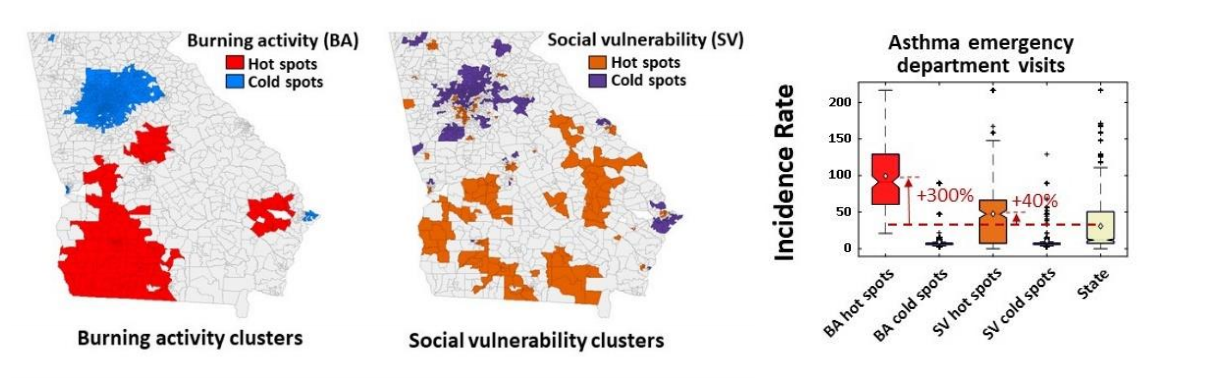
Models show prescribed fire smoke may have health impacts in areas with higher social vulnerability
- Prescribed fire activity in Georgia tends to be concentrated in counties where social vulnerability levels are over 25% higher than the state average7.
- Hundreds of morbidity and mortality cases are potentially associated with prescribed fire smoke in Georgia.
- In areas with high social vulnerability, prescribed fire impacts are comparable to other emission sources such as vehicles and industrial combustion.
- Governments and non-industrial private landowners are the greatest contributors to predicted prescribed fire specific PM2.5 pollution in Georgia
Prescribed fire prevents hazardous air quality from wildfires
- Air quality modeling demonstrates that prescribed fire prevents hazardous air quality events resulting from wildfires.
- Aggregated air quality benefits of prescribed fire are much higher than negative air quality impacts.
- Modeling found that overall more people benefit from prescribed fire than are negatively impacted.
What does this mean for practitioners, public health professionals, and others?
- Modeled prescribed fire impacts to air quality are significantly less than the overall modeled impacts of potential wildfires that would occur without prescribed fire management.
- It is important to understand and mitigate the negative impacts of prescribed fire smoke on communities. This is especially true for socially vulnerable communities who are disproportionately impacted by prescribed fire smoke in Georgia.
References
- U.S. EPA (2014), National Emissions Inventory.
- Melvin (2018), National Prescribed Fire Use Survey Report.
- WHO. (2010). Environment and health risks: a review of the influence and effects of social inequalities.
- Wang et al. (2017). Long-term Exposure to PM2.5 and Mortality Among Older Adults in SE US. https://doi.org/10.1097/EDE.0000000000000614
- Tibuakuu et al. (2018). Air Pollution and Cardiovascular Disease: A Focus on Vulnerable Populations Worldwide. doi.org/10.1007/s40471-018-0166-8
- Wisnivesky et al. (2017). Achieving respiratory health equality. doi.org/10.1007/978-3-319-43447-6_1
- Afrin et al. (2021). Potential impacts of prescribed fire smoke on public health and socially vulnerable populations in a Southeastern U.S. state. https://doi.org/10.1016/j.scitotenv.2021.148712
Related Research
- Afrin, S., Garcia-Menendez, F. (2020). The influence of prescribed fire on fine particulate matter pollution in the Southeastern United States. https://doi.org/10.1029/2020GL088988
- Gaither, C., Goodrick, S., Murphy, B., & Poudyal, N. (2015). An Exploratory Spatial Analysis of Social Vulnerability and Smoke Plume Dispersion in the U.S. South. https://doi.org/10.3390/f6051397
- Johnson Gaither et al. (2019). African American Exposure to Prescribed Fire Smoke in Georgia, USA. Retrieved from https://doi.org/10.3390/ijerph16173079
- Johnson, M. M., Afrin, S., Garcia-Menendez, F. (2020). Evaluation of Smoke Modeling Tools Used for Estimating Air Quality Impacts from Prescribed Burning. https://ui.adsabs.harvard.edu/abs/2020AGUFMA255…03J/abstract
- Huang et al. (2021) Application and evaluation of a low-cost PM sensor and data fusion with CMAQ simulations to quantify the impacts of prescribed burning on air quality in Southwestern Georgia, USA. https://doi.org/10.1080/10962247.2021.1924311
- Rappold et al. (2017). Community Vulnerability to Health Impacts of Wildland Fire Smoke Exposure. https://doi.org/10.1021/acs.est.6b06200