Basic Smoke Management Practices for Prescribed Burning
Dakota Wagner, David Godwin, Christian Fernandez
Originally Written by: David Godwin, Alan Long, and Pete Lahm
Publication ID: Fact Sheet 2024-2 Published: 2014 Revised: 2025, 2026
(View PDF)
Smoke management is one of the biggest hurdles burn managers face when preparing for and conducting a prescribed burn. Smoke is the aspect of prescribed fires that generally carries the most liability as it can impact public health, obstruct visibility on roadways, and be a general nuisance. Smoke produced by wildland fires, including wildfires and prescribed fires, is a large contributor to the United States’ primary emissions of fine particulate matter (PM2.5). It is important for burn practitioners to follow best practices in smoke management to limit its impacts which, in turn, limits the negative public perception of prescribed fire.
National Ambient Air Quality Standards and PM2.5
Fine particulate matter, also known as PM2.5, consists of particles made up of different chemicals, organic compounds, metals, and more that are less than 2.5 micrometers in size. PM2.5 particles are so small that they can embed into lung cavities and enter the bloodstream, posing health risks. In February 2024, the EPA revised one of the National Ambient Air Quality Standards (NAAQS) related to PM2.5. There are two types of NAAQS: primary standards and secondary standards. Primary standards are health-based and aim to protect vulnerable populations, whereas secondary standards are environment-based and strive to protect public welfare. All air pollutants have their own primary and/or secondary standards. The current annual primary standard for PM2.5 is 9.0 micrograms (μg) per cubic meter of air (previously 12.0 μg/m3). Annual standard values are calculated by averaging daily values from January 1 to December 31. In 2024, primary 24-hour standard and secondary standards were not changed.
If counties, states, or regions exceed the annual PM2.5 standard or have multiple exceedances of the 24-hour standard, opportunities for prescribed burning could be severely limited. By working in partnership with state forestry and air quality programs and with adequate smoke management planning, prescribed fire managers can help the Southeast stay within the PM2.5 standards. This will ensure burn opportunities remain attainable across the region.
The 6 Basic Smoke Management Practices
- Evaluate smoke dispersion conditions to minimize smoke impacts.
- Monitor the effects of the fire on air quality.
- Keep records of BSMPs used, fire activity, and smoke behavior.
- Communicate with authorities and the affected public.
- Use emission reduction techniques whenever possible.
- Collaborate with nearby burners to manage smoke emissions.
The 2011 USFS-NRCS Guide to Basic Smoke Management Practices (BSMPs) describes six basic practices that are suitable starting points for prescribed fire planning and operations. Elements of the BSMPs may not apply to all burns due to variations in burn size, fuels, and potential impacts on air quality. Additionally, states may have their own rules and regulations that must be followed. Nonetheless, each practice should be evaluated for application on every burn, even if there is a local smoke management program.
The NRCS guide outlines the six basic practices individually, but for this factsheet, they are grouped into two categories: “before burning” and “during/after burning.”
BSMPs to Use Before Burning
#1 Smoke Dispersion: Develop a smoke management plan that identifies smoke-sensitive areas (SSAs) and details how to reduce impacts to these areas. SSAs include but are not limited to hospitals, schools, major roads and highways, air quality monitors, and animal husbandry farms. Include the necessary weather conditions for desired smoke behavior in your plan, such as wind speeds and direction, temperatures, and atmospheric ventilation rate or dispersion. Running smoke models for your burn units can help burn managers understand potential smoke movement and other areas of impact. Useful resources include VSmoke-web, the Southern Fire Exchange BSMPs Resource Hub, the Smoke Management Guidebook for Prescribed Burning in the Southern Region, and your location’s National Weather Service spot forecast. Do not burn when the dry bulb temperature is predicted to decrease to the dewpoint temperature overnight, as smoke particles may accumulate water condensation and create superfog. For more information on superfog, refer to the Southern Fire Exchange’s factsheet.
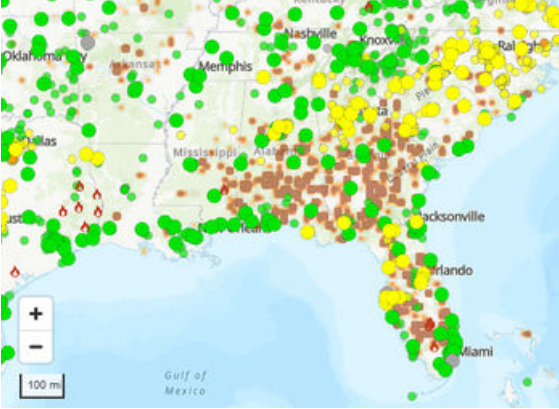
#2 Air Quality Monitoring: Assess regional air quality conditions and forecasts using online resources such as the Fire and Smoke Map. If air quality is poor, consider postponing a burn until conditions improve.
#3 Record-Keeping: Track and document observed weather and air quality conditions as well as current forecasts. This information can be recorded in an online spreadsheet, a personal notebook, or pages attached to your burn plan.
#4 Communications: Notify appropriate authorities, air quality regulators, highway patrol, fire departments, neighbors, and citizens of affected SSAs of anticipated smoke and air quality impacts. Develop contingency plans for potential undesirable impacts and notify appropriate agencies of those plans.
#5 Emission Reduction Techniques: Consider available emission reduction techniques when planning the burn. Possible emission reduction techniques (ERTs) include, but are not limited to, utilizing air curtain incinerators, burning just prior to precipitation, implementing mechanical treatments in tandem with burning, reducing the burn area, and varying ignition techniques (e.g., back fires generally produce smoke at a slower rate than head fires). For more information on ERTs, see the National Wildfire Coordinating Group (NWCG) Smoke Management Guide.
#6 Collaboration: Burn authorization agencies in several southern states determine regional emission loads as part of their authorization process. Checking AirNow.gov and other air quality monitoring resources listed below can inform burn managers of up-to-date air quality readings. Individual burn managers should also collaborate to help avoid local adverse smoke impacts. Burn managers can establish information-sharing networks with others to coordinate burn days and cooperatively reduce acres burned when necessary to prevent adverse smoke impacts.

BSMPs to Use During & After Burning
#1 Smoke Dispersion: During burning, actively monitor weather conditions and forecasts and compare them to the predicted and observed on-site weather conditions and smoke dispersion. After burning, continue to track weather conditions and forecasts to understand the possible effects of lingering smoke from smoldering fuels.
#2 Air Quality Monitoring: Monitor smoke impacts on air quality, particularly near SSAs, using resources such as field reconnaissance and monitoring reports from sources such as AirNow’s Fire and Smoke Map. Larger burns may access satellites, radar, and aircraft for additional information to track smoke movement and air quality impacts.
#3 Record-Keeping: During burning, record BSMPs used on the burn, ignition patterns, on-site weather, fire behavior, smoke dispersion and impacts, size of area burned, fuels burned, and time/date. These records can often be recorded on or attached to your prescribed burn plan. Examples of records include hand-drawn maps, photos, and/or videos. After burning, retain records, observations, and burn plans for five years after the fire in case of an inquiry or an adverse air quality impact.
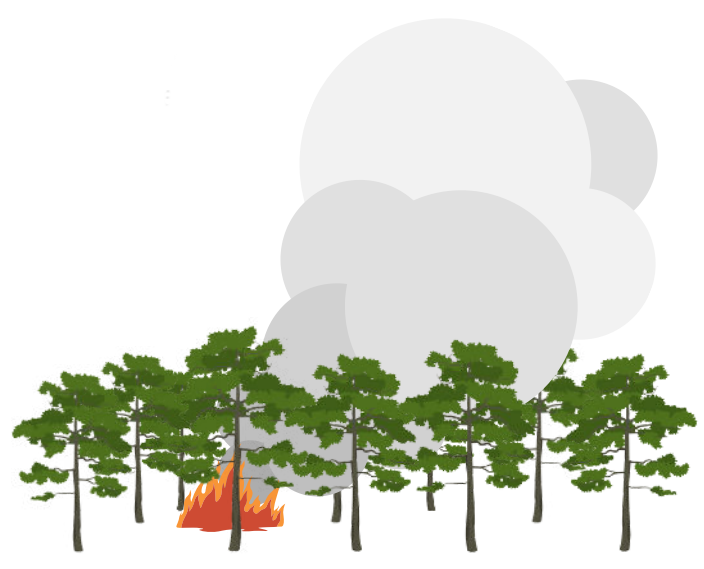
#4 Communication: If travel corridors are, or might be, affected, provide appropriate timely smoke impact updates to authorities, highway patrol, and fire departments during and after the burn. Pay close attention to fuels that may smolder overnight, as this can increase the risk of smoke settling on roads. Smoke on roadways can significantly reduce visibility, especially during periods of high moisture, such as nighttime or early morning hours. The combination of smoke and moisture, known as superfog, is particularly hazardous, as it can completely obscure visibility and cause life-threatening traffic accidents.
#5 Emission Reduction Techniques: Document the use of ERTs and observed effects. Complete mop-up as quickly as possible and extinguish smoldering fuels if necessary to address any adverse impacts.
Resources for Basic Smoke Management Practices:
- USFS-NRCS guide to Basic Smoke Management Practices (BSMPs) https://www.nrcs.usda.gov/sites/default/files/2022-10/Basic-Smoke-Management-Practices-Technical-Note.pdf
- EPA Wildland Fire, Air Quality, and Public Health Considerations Fact Sheet https://www.epa.gov/system/files/documents/2024-02/pm-naaqs-wildland-fire-air-quality-fact-sheet-final.pdf
- Southern Fire Exchange BSMPs Tools and Resource Hub https://southernfireexchange.org/events/archives/basic-smoke-management-practices-bsmps-and-tools/
- VSmoke-Web https://weather.gfc.state.ga.us/GoogleVsmoke/vsmoke-Good2.html
- National Weather Service Fire Weather https://www.weather.gov/fire/
- NOAA Hazard Mapping System Fire and Smoke Product http://www.ospo.noaa.gov/Products/land/hms.html
- Fire and Smoke Map 4.0 (airnow.gov) https://fire.airnow.gov
- USFS BlueSky Playground v3.5 https://tools.airfire.org/playground/v3.5/emissionsinputs.php
- National Wildfire Coordinating Group (NWCG) Smoke Management Guide for Prescribed Fire (PMS 420-3) https://www.nwcg.gov/publications/pms420-3
- USFS Intro to Prescribed Fire in Southern Ecosystems https://research.fs.usda.gov/treesearch/41316
- National Interagency Fire Center Smoke Management Resources https://www.nifc.gov/programs/smoke-management
- NWCG Smoke Committee (SmoC) https://www.nwcg.gov/committee/smoke-committee
- SFE and SERPPAS Webinar on PM2.5 and Exceptional Events https://youtu.be/gT3EYYirZCY?si=nkfEXYPJA7Aku93z
- Smoke Management Guidebook for Prescribed Burning in the Southern Region https://southernfireexchange.org/smoke-management-guidebook-for-prescribed-burning-in-the-southern-region/
- SFE Webinar: A Prescribed Burner’s Guide to the Fire and Smoke Map https://www.youtube.com/watch?v=CSuemW4E5wg