Be Smoke Savvy: Georgia Prescribed Fire Smoke Management Pocket Guide
Christian Fernandez, Shan Cammack, Anthony Kroeger, David Godwin
Publication ID: Fact Sheet 2025-6 Published: 2025 Revised: 2026
(View PDF)
Being Smoke Savvy: An Introduction
Smoke management is a critical component in prescribed burn planning. Preparing for the movement and impacts of smoke can protect both prescribed burners and the public. It is easy to understand how smoke can be a hazard. Reduced roadway visibility associated with smoke from prescribed fires and wildfires have led to multiple vehicle accidents across the southeast. Prolonged exposure to smoke has been linked to a wide range of negative health effects, and certain individuals are extremely sensitive to even relatively minor exposures to smoke. Being smoke savvy means planning for, preparing for, and actively managing prescribed fire smoke to minimize impacts on smoke sensitive targets (like schools, hospitals, highways, densely populated areas, etc.) as well as considering your shared airshed.
Thinking in the Shared Airshed
The smoke produced from fire, prescribed or otherwise, enters a shared atmosphere. To visualize this, imagine you’re a landowner wanting to conduct a prescribed burn on your property northwest of Sandersville, a small town between Augusta and Macon. Most of the weather parameters are well within prescription–like temperature and relative humidity, along with smoke-related variables like transport wind, mixing height, and dispersion index–which makes today a great day to burn. However, there’s a northwest wind that could carry your smoke to a populated area just southeast of you. You think, “The little bit of smoke I produce can’t possibly be a problem for that town.” But, a good day for you to burn is probably a good day for your neighbors to burn. On your own, the smoke produced from your prescribed burn may be relatively inconsequential. You and your neighbors’ combined smoke, however, may be more impactful than you realize! This is thinking about the shared airshed. You and your neighbors–not just in the county–but across the state share the same atmosphere in which smoke travels and disperses.
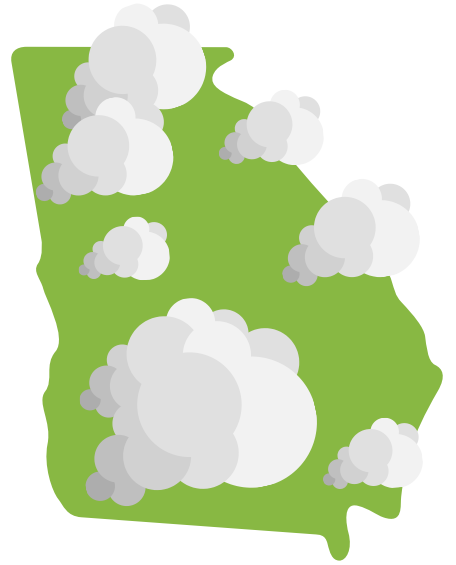
When planning your smoke management for a prescribed burn, you should consider the prescribed fire activity around you. To reduce your impact on the shared airshed you might consider burning smaller units at a time or burning during different seasons to spread smoke throughout the year. Communicate and coordinate with your neighbors to mitigate your shared smoke impacts and keep prescribed burners burning! Be patient when there are days that atmospheric conditions are not conducive to handle your smoke and you aren’t issued a permit from Georgia Forestry Commission.
The Smoke Savvy Checklist
Before the Burn
- Understand and follow local, state, and federal prescribed burn laws and regulations. Obtain a burn permit through the Georgia Forestry Commission.
- Write a burn plan that lists objectives of burn, smoke management, and contingency plans.
- Choose appropriate weather for fire and smoke. Use the Fire Weather Dashboard.
- Identify, map, and avoid impacting smoke sensitive areas.
- Match smoke screening tools appropriately to burn complexity.
- Be aware of other burning and air quality in your area. Check in on the Georgia Wildfire Viewer. Consider that you are sharing the airshed with other burners.
- Be a good neighbor and notify appropriate parties that you are burning.
Smoke Watch Outs
- Sea Breezes
- Heavy Fuels
- Large Piles
- Logging Slash
- Long Unburned Stands with Duff Smoldering Potential
During the Burn
- Use a test fire to check expected smoke lift & dispersion.
- When feasible, use ignition patterns and methods which minimize smoke production and maximize lift.
- Finish ignition early to promote smoke lift.
- Monitor changing weather conditions and respond to unintended smoke Impacts.
- Be aware of smoke watch outs.
- Consider contingency plans to cut burns off if smoke becomes an issue.
After the Burn
- Minimize impacts from smoldering fire using appropriate mop-up standards.
- Include smoke management in your Debrief or After-Action Review.
- Know the weather forecast for that night and the following day and make sure they are appropriate for lingering smoke.
- Be aware of where your smoke goes at night (think about down drainage).
- Enhance your smoke management skills through training and experience.
This publication serves as a pocket guide, but not a comprehensive resource for smoke management in Georgia. Scan the QR Code to the right or visit https://southernfireexchange.org/wp-content/uploads/2025-5.pdf for a publication with links to important smoke management resources.