Basic Smoke Management Practices (BSMPs) and Tools
BSMPs
BSMP Introduction
Basic Smoke Management Practices (BSMPs) are important for prescribed burners to consider when planning and implementing prescribed fires and following BSMPs may help the land management community to maintain prescribed fire as a socially-accepted practice. On this page, we have assembled a collection of resources that explain BSMPs and may be helpful for prescribed burners in implementing BSMPs on their lands. Do you have resources that we should include on this page? If so, please let us know ([email protected]).Â
BSMPs are intended to be supplemental practices for minimizing the impacts of prescribed fire smoke on communities and regional air quality. It is important to understand that following BSMPs does not supersede local, regional, or state air quality rules or regulations.Â
Health and Safety
Managing smoke reduces the potential health risks associated with poor air quality. Smoke from prescribed burns contains particulate matter and other pollutants that may exacerbate respiratory issues and cause discomfort for nearby communities. By implementing basic smoke management practices, burners can minimize these risks and protect public health.
Minimize Negative Impacts
Smoke can have adverse effects on visibility, transportation, and outdoor activities in nearby areas. Basic smoke management practices help minimize these negative impacts by dispersing smoke more effectively and reducing its duration and intensity.
Preserve Public Acceptance
Prescribed burning is an essential tool for land management and ecosystem health. However, negative experiences with smoke can lead to public opposition and reluctance to support future prescribed burning efforts. By managing smoke effectively, burners can maintain positive relationships with local communities and stakeholders, fostering understanding and support for prescribed burning activities.
Enhance Effectiveness
Proper smoke management can improve the overall effectiveness of prescribed burns. By controlling smoke dispersion, burners can achieve their desired burn objectives more efficiently, whether it's reducing fuel loads, promoting ecosystem health, and improving wildlife habitat.
By implementing these basic smoke management practices, prescribed fire practitioners can minimize the impact of smoke on air quality and public health while still achieving land management objectives. For more information about the health effects of smoke and tools for helping communities prepare for wildland smoke, check out AirNow.gov/wildfires.
BSMP Fundamentals
NRCS Basic Smoke Management Practices for Prescribed Burning Fact Sheet
This is the USDA Forest Service and NRCS document that started it all. The NRCS Basic Smoke Management Practices fact sheet introduces the six BSMPs, and explains why and how prescribed burners should use BSMPs.
The video dives into each of the BSMPs.
BSMP Fundamentals
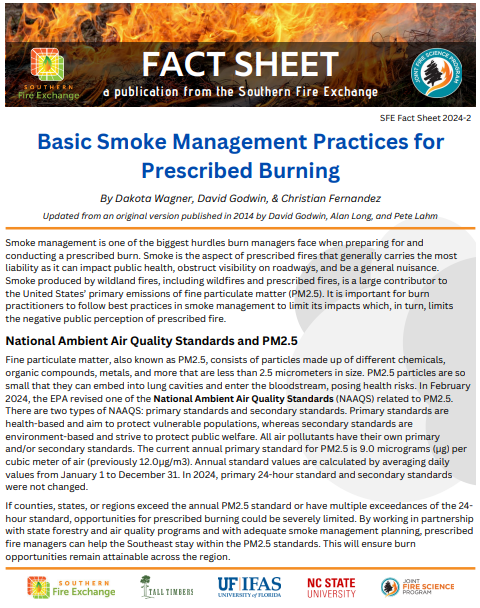
SFE Basic Smoke Management Practices for Prescribed Burning Fact Sheet
In 2024, the SFE team developed an updated four-page fact sheet describing the Basic Smoke Management Practices as well as tools and resources for smoke management planning. This fact sheet provides resources and considerations that expand upon the original NRCS fact sheet.
BSMP Fundamentals
Basic Smoke Management Practices and Tools to Promote Cleaner Air
This 2024 presentation by Shan Cammack, prescribed fire program manager for the Georgia DNR was originally shared at the Georgia Prescribed Fire Council Meeting. Over a short 20-minute presentation, Shan covers a wide range of practices, tools, resources, and tips for being a responsible prescribed fire smoke manager.
BSMP Fundamentals
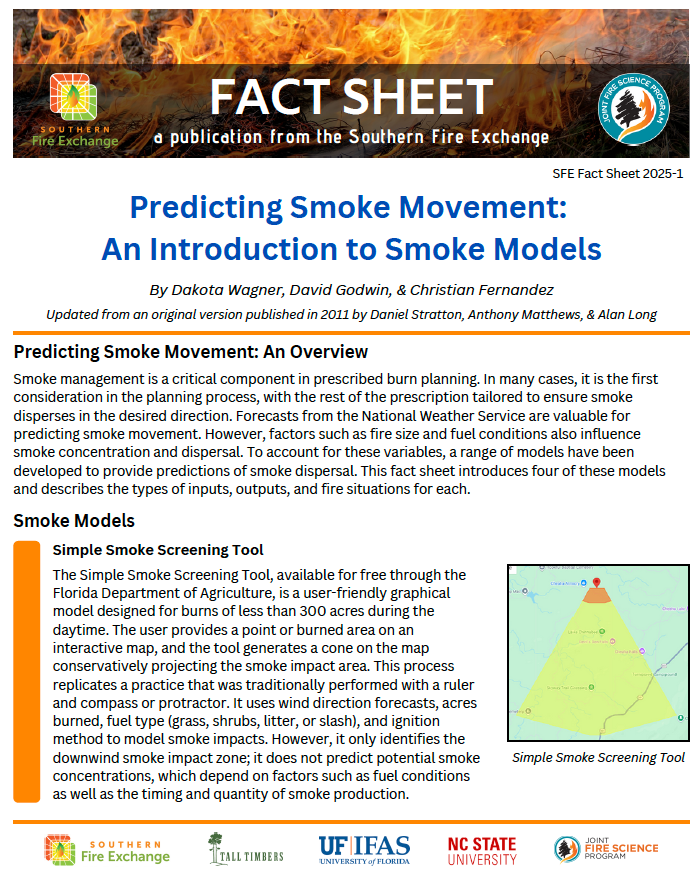
SFE Predicting Smoke Movement: An Introduction to Smoke Models Fact Sheet
This short fact sheet from the Southern Fire Exchange describes the basic benefits, inputs, and outputs of four different computer models for predicting smoke movement in the southeast US. This fact sheet was updated in 2025 to replace an original version published by the Southern Fire Exchange in 2011.
Smoke Management Planning Tools
USDA Forest Service and EPA Fire and Smoke Map
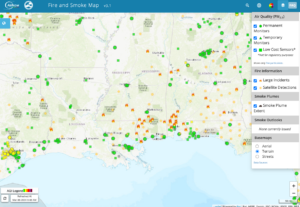
The USFS / EPA Fire and Smoke Map is a one-stop-shop for viewing regional air quality trends, smoke movement, satellite fire detections, and air monitoring stations. Importantly, the Fire and Smoke Map shows both permanent air quality monitors (i.e. state monitoring stations) and personal low-cost air quality sensors (i.e. Purple Air). Knowing the location of these monitoring stations and sensors can be helpful information for prescribed burners. We have a SFE webinar that explains everything you need to know about the Fire and Smoke Map.Â
Smoke Management Planning Tools
Georgia DNR Winds and Air Quality Map
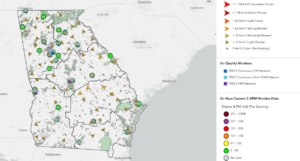
Georgia DNR Winds and Air Quality Monitors Map – This map provides an easy way to view air quality monitor locations, current PM 2.5 AQI levels, and surface wind observations.
Smoke Management Planning Tools
Smoke Conditions in the Southeast Map
Tall Timbers Smoke Conditions in the Southeast – This tool provides an easy way to visualize current smoke and air quality conditions across the southeast, along with current wind directions and satellite smoke observations.
Smoke Management Planning Tools
Kansas Flint Hills Smoke Management Tools
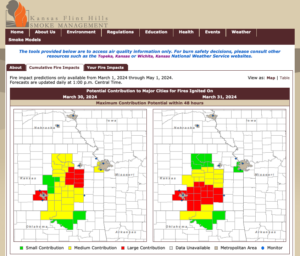
The Kansas Flint Hills Smoke Management Tools provide Kansas-specific resources for predicting potential prescribed fire smoke impacts to counties across and adjacent to Kansas. The website provides a county-by-county visual indication of potential smoke impacts as well as forecast discussions of smoke impacts and burning conditions.
Smoke Management Planning Tools
Simple Smoke Screening Tool
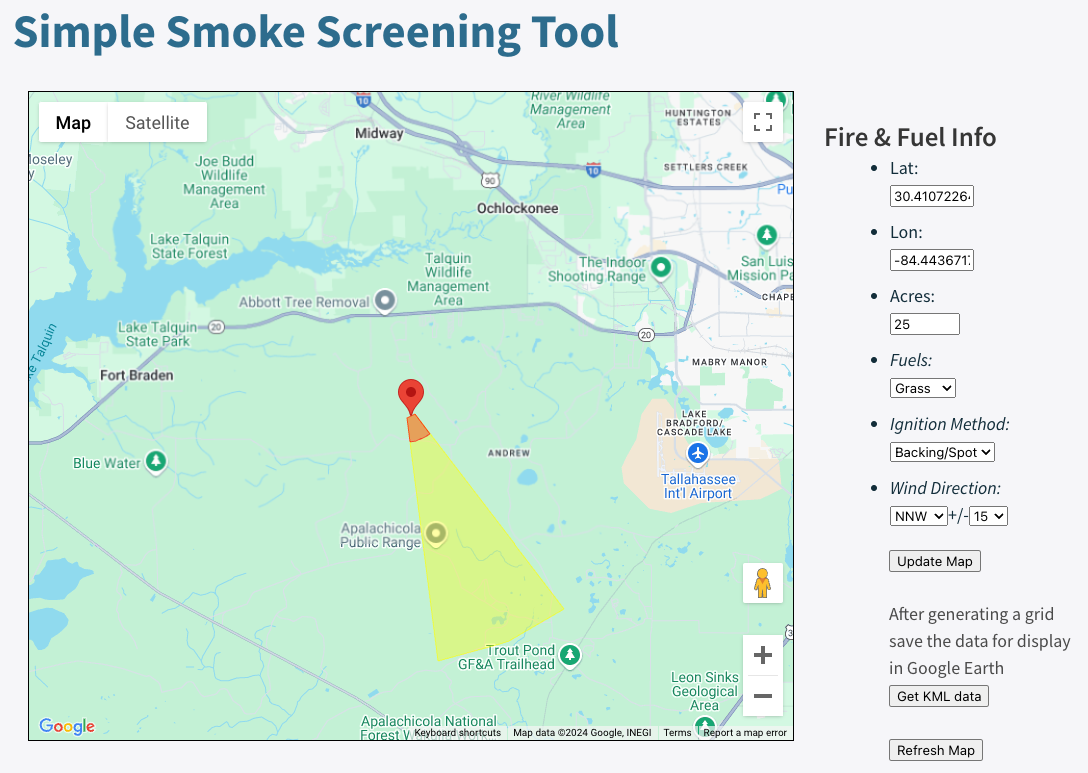
The Simple Smoke Screening Tool (hosted by the Florida Forest Service) is a browser-based tool for plotting on an interactive map potential smoke movement and concentration. This tool does not incorporate dynamic (changing) weather or ignition techniques, but it provides a simple and easy-to-interpret method for smoke planning. If you have never tried smoke modeling before, this is probably the best place to start.
Smoke Management Planning Tools
VSmoke-Web
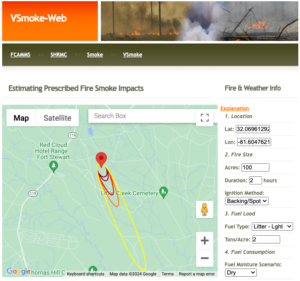
The VSmoke-Web online smoke modeling tool is hosted by the Georgia Forestry Commission. If you are familiar with the Simple Smoke Screening Tool, VSmoke-Web offers more advanced smoke modeling options and outputs. The Southwest Georgia Prescribed Burn Association and the Southern Fire Exchange each have online presentations that explain how to use VSmoke-Web.
Smoke Management Planning Tools
BlueSky Playground
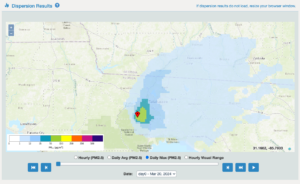
The USDA Forest Service BlueSky Playground is a browser-based interface for advanced emissions and smoke modeling for prescribed fires and wildfires. BlueSky includes tools for defining burn units, estimating emissions, and predicting smoke movement and concentration. BlueSky allows users to run VSmoke-Web smoke models and HYSPLIT for defined fires. Prior to using the BlueSky Playground in a planning or operational context, you will want to review the BlueSky Documentation.
Smoke Management Educational Resources
NWCG Smoke Committee
The NWCG Smoke Committee Portal is an extensive resource for learning about smoke, air quality, and smoke management.
Smoke Management Educational Resources
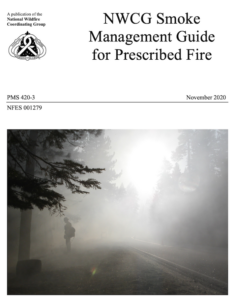
Smoke Management Guide for Prescribed Fire (PM-420-3)
The NWCG Smoke Management for Prescribed Fire (PM-420-3) is the nearly 300-page national standard resource for understanding smoke management and planning.
Smoke Management Educational Resources
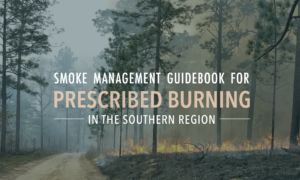
Smoke Management Guidebook for Prescribed Burning in the Southern Region
This 2020 publication was developed through a collaboration among the EPA, NC State University, Southern Fire Exchange, Southern Regional Extension Forestry, and the University of Georgia. A full-color guidebook, it includes a wide range of information about smoke production, composition, and planning.