
Terrestrial Invasive Plants and Fire
Jennifer Fill, Raelene Crandall
Publication ID: Fact Sheet 2019-2 Published: 2019 Revised: 2026
(View PDF)
Invasive plants complicate management on lands where fire is used to maintain native communities. Invasive species can make it difficult to achieve prescribed fire objectives (for example, by changing fire intensity and fuel continuity), especially when they are resilient to fire.
Stages of Invasion
Invasive plants can be affected by fire at one or more stages of the invasion process: 1) colonization by seed or vegetative propagules, 2) survival and reproduction, 3) growth or increase in density by spreading vegetatively or by seed (low density, but increasing), and 4) dominance, in which a species is not only very abundant but also suppresses other species.
Invasive plants vary in their sensitivity to fire during the invasion process. Some species are sensitive to fire management at all stages. Both seeds and non-sprouting adult plants experience high mortality after fire such that the species is unable to reproduce, spread, and become dominant in fire-frequented environments. In other cases, invasive species are resilient to occasional fire. Fire can stimulate germination in these species and promote spread, but fires that occur too frequently or before plants begin to reproduce can kill adult plants, deplete the seed bank, and prevent dominance at a site. Some species are unaffected or even promoted by fire. These species are often the most difficult to control, because they tend to survive fire by resprouting followed by rapid growth and sometimes abundant seed production that allows them to quickly gain dominance. Fire-plant relationships can change over time and are influenced by the environmental context, including the native community assemblage, soil fertility and hydrology, and presence of pests and pathogens.
Invasive plants are a concern in fire management when they influence fire regimes. Some species, such as cogongrass (Imperata cylindrica), produce abundant biomass that greatly increases fuel loading and generates intense fires. Other species, such as Chinese tallow (Triadica sebifera), shade out understory fine fuels or produce dense litter that holds moisture and suppresses fire. Typically, the effects that plants have on the fire regime will increase as their density increases.
The following table summarizes our current knowledge of the fire ecology of several common invasive plants in fire-frequented habitats of the southeastern US.
| Species | Growth Form | Environments it Invades | Effects on Fire | Post-Fire Response | Additional Characteristics |
|---|---|---|---|---|---|
| Tree of heaven (Ailanthus altissima) | Tree | Disturbed forests, edges, open areas | No effect, but could produce toxic smoke when burned |
• Established plants resprout from base and roots • High postfire seedling establishment from many winddispersed seeds that germinate on open ground |
• Seedlings can establish on burned and unburned sites • Grows best in high nutrient and open canopy conditions • Chemicals in leaves, bark, and seeds inhibit growth of nearby plants |
| Callery pear (Pyrus calleryana) | Tree | Disturbed forests, old fields, open areas | No particular effect |
• Seedlings 2 years and older resprout • Fire kills seeds and seedlings up to 1 year old |
• Thought to be sterile but different varieties in close proximity can crosspollinate |
| Chinese tallow (Triadica sebifera) | Tree | Streams, floodplains, uplands | Lack of fuel under dense stands so fire does not spread |
• Resprouts vigorously from base and roots • Canopy is not flammable |
• Small trees are more vulnerable to fire, so they are unlikely to invade frequently burned areas • Annual spring burning can reduce seedling growth • Thick bark in older trees protects them from fire • Shortlived seed bank |
| Sericea lespedeza (Lespedeza cuneata) | Shrub | Bottomlands, grasslands | No particular effect |
• Resprouts from root crown • Regenerates from large seedbank in soil • Populations promoted by fire |
• More vulnerable to late summer fires • Winter fires promote seed germination • Seeds are viable for up to 20 years |
| Brazilian pepper (Schinus terebinthifolia) | Shrub | Disturbed areas, moist to dry sites | Dense closed-canopy stands limit fine fuels so fire does not spread |
• Seeds have limited heat tolerance • Resprouts from aboveground stems and root crown • Burned individuals might produce fewer seeds |
• More vulnerable to fire at small sizes and at low densities • Less likely to colonize frequently burned sites, especially those that are undisturbed, but can colonize recently burned areas |
| Chinese privet (Ligustrum sinense) | Shrub | Riparian and upland habitats | Moist conditions under dense stands reduce fire spread and intensity |
• Resprouts from root crowns or roots |
• Seedlings are more vulnerable than adults |
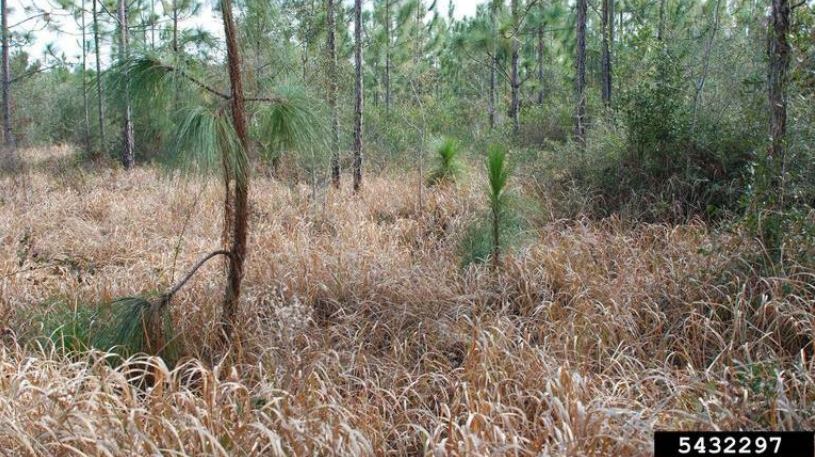
| Cogongrass (Imperata cylindrica) | Grass | Disturbed areas, moist to dry sites | Increases fire intensity and spread |
• Quickly resprouts from rhizomes • Able to outcompete native species after fire |
• Produces abundant seeds that establish in a variety of conditions, especially disturbed areas • Burns intensely at any time of year • Heavy litter accumulation |
| Kudzu (Pueraria montana var. lobata) | Vine | Forest edges, disturbed areas, moist to dry soils |
• Ladder fuels increase crown fire potential • High moisture content reduces fire intensity and spread during summer • Dry fuels in winter could burn intensely |
• Resprouts from subsurface root crown after fire • Soil heating could promote seed germination |
• Quickly develops a deep taproot and spreads via belowground rhizomes • Dense kudzu litter inhibits germination of other plants |
| Air potato (Dioscorea bulbifera) | Vine | Open or disturbed areas and in riparian zones | Ladder fuels increase crown fire potential |
• Resprouts from tubers • Larger bulbils have higher survival after fire |
• Abundance increased after 3 years of annual March fires in sandhills (prior to vine emergence) • Longer bulbil viability when buried under litter |
| Old world climbing fern (Lygodium microphyllum) | Vine | Moist habitats and swamps |
• Ladder fuels increase crown fire potential • Pieces of fern could break off and start spot fires |
• Resprouts rapidly after fire |
• Spores spread by wind |
What is the stage of invasion?

Early – Most plants are young/not reproductive
Late – Plants are established and reproducing
What is the size of invasion?
Small – Few plants scattered across the landscape
Large – Invasive dominating or nearly dominating across the landscape
How does the invasive species affect fire?

No effect
Negative – Invasive decreases fire frequency and intensity
Positive – Invasive increase fire frequency and intensity
How does the invasive species regenerate after fire?
Reseeder – Regeneration is by seed only; adult plants do not survive fires
Resprouter – Regeneration is primarily by resprouting from root crowns
Reseeder/Resprouter – Both regeneration methods are common after fire
How does fire affect the invasive species?

No effect
Negative – Fire decreases density of invasive species
Negative, but depends on burn season – fire decreases density of invasive species when sensitive (i.e., when plants are reproducing
Positive – Fire increases density of invasive species
Do other methods need to be considered instead of or in addition to prescribed fire?
Zero bold questions, No – but proceed with caution and continue monitoring invasive density and spread
One or more bold answers, Yes consider controlling invasive prior to of in conjunction with fire
If one or more questions have a bold answer, carefully consider the benefits of applying prescribed fire prior to reducing invasion size and extent.
Key Management Considerations
Fire management can target fire-resilient species as seeds or as adults. Fire can be used to kill some seeds on the soil surface or those still on reproducing plants. Mature plants that resprout after fire are rarely killed by a single fire. Often very frequent (annual) fires can slow population spread but will likely not eliminate invasive species unless populations are low-density or composed of mainly young plants. When densities are high, mechanical or chemical removal methods should be considered (e.g., mature kudzu vines), especially if the invasive is known to alter the fire regime by increasing (e.g., cogongrass) or decreasing (e.g., Brazilian pepper) intensity and spread.
Burning when populations are sensitive to fire will also reduce recovery after fire. For instance, it is recommended, when possible, to burn when plants are flowering or producing seeds to reduce seed production and germination after fire. Ultimately, outcomes will depend on habitat type, coexisting species, and stage of invasion. Each invasion should be carefully and individually considered before management actions are taken.
Additional Resources:
More specific resources for invasive plant management recommendations can be found by contacting your local/state Cooperative Extension office and by searching on the US Forest Service TreeSearch search engine (https://www.fs.usda.gov/treesearch/).
References
- Brooks, M. and M. Lusk. 2008. Fire Management and Invasive Plants: a
Handbook. United States Fish and Wildlife Service, Arlington Virginia, 27 pp. - Crandall RM, Knight TM (2018) Role of multiple invasion mechanisms and their interaction in regulating the population dynamics of an exotic tree. Journal of Applied Ecology 55:885-894
- Grace JB, Smith MD, Grace SL, Collins SL, Stohlgren TJ (2001) Interactions between fire and invasive plants in temperate grasslands of North America. In: Galley KEM, Wilson TP (eds) Proceedings of the Invasive Species Workshop: the Role of Fire in the Control and Spread of Invasive Species. Fire Conference 2000: the First National Congress on Fire Ecology, Prevention, and Management. Miscellaneous Publication No. 11, Tall Timbers Research Station, Tallahassee, FL, pp 40–65
- Guthrie, SG Crandall RM, Knight TM (2016) Fire indirectly benefits fitness in two invasive species. Biological invasions 18:1265-1273
- Warrix, AR, Marshall, JM (2018) Callery pear (Pyrus calleryana) response to fire in a managed prairie ecosystem. Invasive Plant Science and Management 11:27-32
- Stevens, JT, Beckage, B (2009) Fire feedbacks facilitate invasion of pine savannas by Brazilian pepper (Schinus terebinthifolius). New Phytologist 184:365-375
- Stevens JT,, Beckage B (2010) Fire effects on demography of the invasive shrub Brazilian pepper (Schinus terebinthifolius) in Florida pine savannas. Natural Areas Journal 30:53-63
- USDA Fire Effects Information System. https://www.feis-crs.org/feis/
- Zouhar K, Smith JK, Sutherland S, Brooks ML (2008) Wildland fire in ecosystems: fire and nonnative invasive plants. Gen. Tech. Rep. RMRS-GTR-42-vol. 6. Ogden, UT: U.S. Department of Agriculture, Forest Service, Rocky Mountain Research Station