The Value of Forming a Prescribed Burn Association (PBA)
John Diaz1, Jennifer E. Fawcett2, John R. Weir3
1University of Florida
2North Carolina State University
3Oklahoma State University
Publication ID: Fact Sheet 2016-2 Published: 2016 Revised: 2021, 2026
(View PDF)
Introduction
Prescribed burning is the application of fire to the landscape to meet multiple land management objectives.1 It is one land management practice that can be used to restore the natural balance of ecosystems in a safe and calculated way, while also reducing wildfire risk. While most plant communities in the South are dependent on fire to maintain plants and native wildlife, many lands do not receive as much fire as they need.
In the South, the majority of forest land is privately owned. This means that the ability to manage fire-dependent and fire-adapted ecosystems is contingent upon the private landowner’s capacity to use prescribed fire on their lands. Many landowners already use prescribed fire for accomplishing their management goals, but most do not. To some, burning is viewed as a risky and daunting task, which hinders their willingness to utilize prescribed fire. However, evidence shows that with the help of neighbors and other landowners, prescribed burning is easier, safer, and more economical than when trying to burn on one’s own.2,3,4
The development of Prescribed Burn Associations (PBAs) is becoming an increasingly popular approach to increase private landowner’s ability to utilize prescribed fire.
What is a Prescribed Burn Association?
PBAs can be formed at various levels, such as local, county, or multi-county, depending on the need. A state-level PBA, such as the Prescribed Burn Alliance of Texas (www.pbatexas.org) or Oklahoma Prescribed Burn Association (www.ok-pba.org), can also be formed to support existing local, county, or multi-county PBAs and to help develop new PBAs within the state. These larger-scale PBAs can assist local organizations by providing additional resources, promoting the establishment of local PBAs, and advocating in state legislatures and regulatory agencies. Such state-level fire coalitions and prescribed fire councils were a driving force in passing “Right-to-Burn Acts” that established prescribed burning as essential to maintaining and restoring ecological integrity.5
In 2015, there were 62 known PBAs in eight states, along with two statewide burn associations (Oklahoma and Texas) and one regional alliance.4 This represents an increase from the 50 PBAs that were in existence as of 2012. In 2016, a new PBA was developed in North Carolina (North Carolina Sandhills Prescribed Burn Association) increasing the current figure to 63.6 By 2021, the number of PBAs has increased to 70 and spread to 12 different states.12
For more information and an interactive map of existing PBAs, please visit https://gpfirescience.org/agencies/.
What is a Prescribed Burn Association?
According to surveys, landowners have listed several reasons they do not burn.7,8,9 These surveys identified the following major barriers, which are described in more detail below:
- Liability concerns
- Lack of capacity
- Lack of training and/or experience
- Resource concerns (including limited access to equipment)
- Weather (including narrow burn windows and limited burn days)
Prescribed Burn Associations can help members to
- Obtain insurance and effectively manage risk by addressing the other needs,
- Increase available peer support to burn,
- Gain experience through assisting with burns,
- Take advantage of narrow burn windows by deploying quickly and having multiple groups burning at once, and
- Pool equipment to increase resource availability.
Liability
The fear of liability is arguably the most significant concern related to prescribed burning among landowners. By increasing capacity, experience, and equipment through a PBA, liability risk will subsequently be reduced. Planning burns with multiple landowners, where neighbors assist one another, reduces liability as well because if a landowner burns only their property, the biggest concern is keeping the fire on their property. If multiple landowners plan their burns together, they allow fire to pass freely from one property to another without the worry or fear of liability. This also can make burning more economical due to using natural or man-made firebreaks that may exist on a neighboring property, along with burning larger blocks at once, thus reducing costs, time, and number of burn days needed.
PBAs exhibit relative success in mitigating issues of liability in relation to the occurrence of spotfires (a fire started by flying sparks or embers at a distance from the main fire) and escaped burns. A study by Weir et al. found that spotfires occurred on prescribed burns conducted by PBAs at the identical rate (1 of 5 burns) relative to experienced crews within the same region.4 They also found that only 1.5% of a total of 1,094 fires conducted by PBAs escaped, with no reported insurance claims against any of the PBAs or members. This demonstrates that PBAs can manage spotfires and mitigate the potential for escaped burns.
Also, in some cases, PBAs can provide prescribed fire liability insurance at an affordable rate to landowners through a group discount. Potential damages caused by escaped fires, suppression costs, injury to people assisting with the burn, or problems caused by smoke are usually covered with insurance. A minimal annual fee and additional charge may incur for each burn the landowner would like to have insured.
Capacity
Training and Experience
Resources
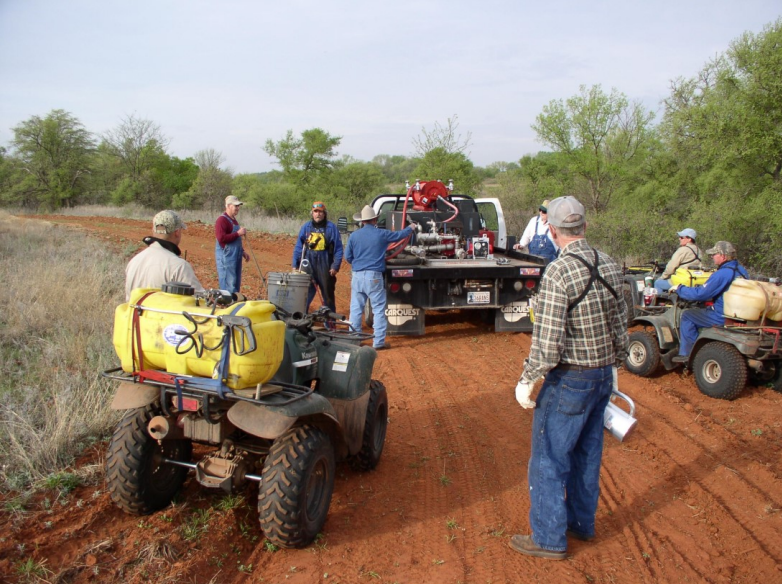
In the same survey of PBAs, members indicated that drip torches, radios, slip-on pump units and ATV sprayers, ATVs, weather instruments/kits, utility vehicles, flappers/swatters and fire rakes were commonly used on burns.4 Gloves, flame retardant shirts and pants, and goggles/safety glasses were reported as the personal protective equipment most frequently worn on burns. Members identify the value of pooling their equipment so no one person has to buy all of the equipment needed to burn. Some PBAs partner with their local fire department to rent or use equipment for conducting burns, as well as having the local fire department present with additional manpower and equipment for burns.3
In addition to equipment, PBAs can receive funding through grants or donations. The aforementioned survey found that all responding PBAs received funding in the form of private donations, nongovernmental organization grants and donations, along with state and federal grants ranging from $500 to $250,000.4 The funds have been used for needs such as equipment and training activities.
Weather
Summary
The total value of forming a PBA is not only realized by one individual, but by many. The services resulting from an active PBA benefit neighbors, as well as the community through healthy forests and rangelands, reduced wildfire impacts, and the multitude of other benefits that prescribed burning provides. A video, produced by the North Carolina Sandhills Prescribed Burn Association, depicts the value of this PBA to its members: https://youtu.be/HaHt6ZLYd3o. More information about forming a PBA is available at http://pods.dasnr.okstate.edu/docushare/dsweb/Get/Document-2819/F-2880web.pdf.
References
- Waldrop, T. A., & Goodrick, S. L. (2012). Introduction to prescribed fires in Southern ecosystems (Science Update SRS-054). Ashville, NC: U.S. Department of Agriculture Forest Service, Southern Research Station. 80p.
- Weir, J. R. (2010). Prescribed burning associations: Landowners effectively applying fire to the land. In K. M. Robertson, K. E. M. Galley, & R. E. Masters (Eds.), Proceedings of the 24th Tall Timbers fire ecology conference, The future of prescribed fire: Public awareness, health, and safety (pp. 44–46). Tallahassee, FL: Tall Timbers Research Station.
- Weir, J. R., Stevens, R. L., & Bidwell, T. G. (2010). Prescribed fire associations (Oklahoma State University Cooperative Extension Service Publication NREM-2880, revised November 2015). Retrieved from: http://pods.dasnr.okstate.edu/docushare/dsweb/Get/Document-2819/F-2880web.pdf
- Weir, J. R., Twidwell, D., & C. L. Wonkka. (2015). Prescribed burn association activity, needs, and safety record: A survey of the Great Plains (Great Plains Fire Science Exchange Publication 2015-6). Retrieved from: https://static1.squarespace.com/static/55687b65e4b0bd1f0f6f4548/t/55d61160e4b0b9bb407f5047/1440092512828/PBAsurveyWeiretal2015-6rev.pdf
- Weir, J. R., Twidwell, D., & Wonkka, C. L. (2016). From grassroots to national alliance: The emerging trajectory for landowner prescribed burn associations. Rangelands, 38(3): 113–119.
- Wimberley, J., & Wagner S., (2016). Kickoff meeting of the NC Sandhills Prescribed Burn Association. Longleaf Leader Magazine, 16–17. Retrieved from: https://serppas.org/media/1978/2016-04longleafleaderpbaarticle.pdf
- Association of Fish and Wildlife Agencies, Forestry Work Group. (2015). Survey: Prescribed burning on private lands. (Unpublished report).
- Kobziar, L. N., Godwin, D., Taylor, L., & Watts, A. C. (2015). Perspectives on trends, effectiveness, and impediments to prescribed burning in the southern U.S. Forests, 6, 561–580.
- Wallace, P., & Livingston, K. (2014). Prescribed fire use survey for landowners in North Carolina. (Unpublished report).
- Melvin, M. A. (2015). 2015 national prescribed fire use survey report. Retrieved from: www.stateforesters.org/sites/default/files/publication-documents/2015%20Prescribed%20Fire%20Use%20Survey%20Report.pdf
- Stevens, R. (2013). Association represents prescribed burn practitioners. Ag News and Views. The Noble Foundation. Retrieved from: www.noble.org/ag/wildlife/burn-practitioners
- North Carolina State University (2021). Prescribed burn associations. Retrieved from: https://research.cnr.ncsu.edu/blogs/southeast-fire-update/prescribed-burn-associations/