
Mechanical Treatments and Herbicides as Fire Surrogates: State of the Science in Florida Ecosystems
1Southern Fire Exchange
Publication ID: Fact Sheet 2014-5 Published: 2014 Revised: 2021, 2026
(View PDF)
Introduction
How effective are non-fire vegetation treatments for achieving ecosystem restoration and management goals? This has been the main question in dozens of research studies during the last 25 years. Researchers Eric Menges and Doria Gordon published a paper in Florida Scientist in 20101 that reviewed more than 18 research studies and 112 publications that addressed that very question. While the authors focused specifically on the impacts of such treatments on Florida ecosystems, their findings have relevance to other southern Coastal Plain states with areas containing sandhill, scrub, dry prairie, and flatwoods ecosystems. Although direct comparison among the research projects was hindered by differences in experimental design, length of time treatments were evaluated, and treatment characteristics, Menges and Gordon concluded their review with a set of generalities and recommendations based on some similar conclusions drawn from the studies. This fact sheet summarizes the key points and management implications that Menges and Gordon developed in their review.
Mechanical and Herbicide Treatments can Accelerate Structural Changes.
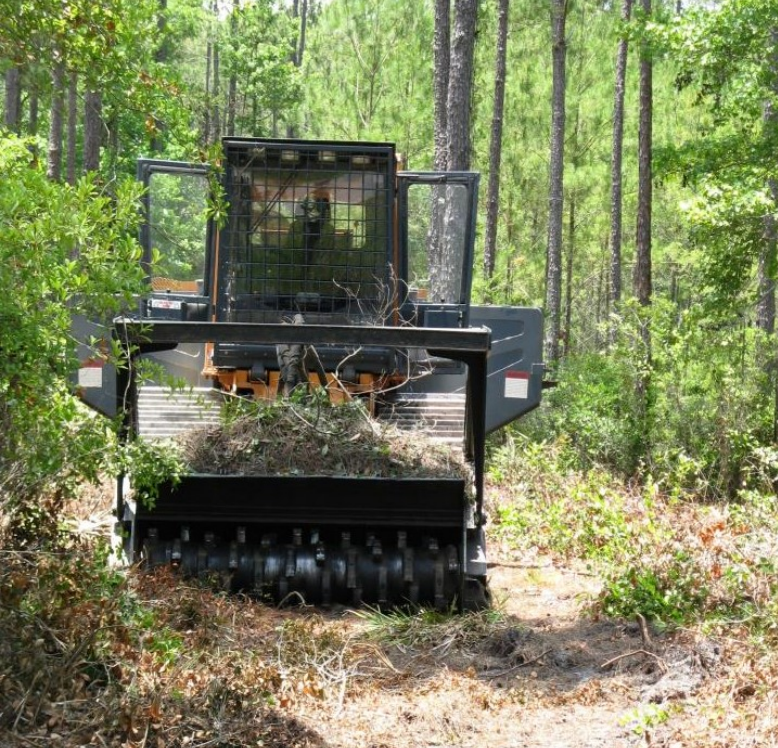
Many of the studies took place in long unburned sites with dense shrub and/or hardwood layers. Frequently, a key objective was to reduce these layers to facilitate the reintroduction of prescribed fire, promote herbaceous layer diversity and cover, and enhance wildlife habitat. Mechanical methods included logging, mowing, roller-chopping, chainsaw felling, or girdling. Herbicides were most often hexazinone in granular formulation or liquid spot applications. Although mechanical treatments were effective in reducing shrubs and hardwoods in the short-term (1-2 years post treatment), resprouting generally resulted in returns to pretreatment conditions within a few years. Herbicide applications, however, tended to lengthen control of subsequent hardwood and shrub resprouting. In most ecosystems, coupling mechanical treatments and herbicides with fire was best at reducing hardwoods and saw palmetto.
Mechanical and Herbicide Treatments are Best when Followed by Prescribed Fire.
In most of the studies, other ecological benefits were also generally better when fire followed the other treatments than when mechanical or herbicide treatments were applied without fire. Such ecological benefits included improved wildlife habitat via increased herbaceous and grass diversity / cover and reductions in palmetto cover. In pine flatwoods and dry prairies, combined treatments resulted in short-term (flatwoods) and long term (dry prairies) increased grass and herbaceous species and reduced saw palmetto, regardless of season.
Some Species do not Respond to Mechanical and Herbicide Treatments.
Some arthropod, herpetofauna, and plant species only responded to prescribed fire and not mechanical treatments. This trend was seen in all ecosystems reviewed, including scrub, sandhill, dry prairie, flatwoods, and pine rocklands. For these species, mechanical and herbicide treatments may not achieve all restoration and management goals. This further supports the importance of following such treatments with prescribed fire, or using prescribed fire alone where fuel conditions allow.
When Mechanical and Herbicide Treatments are used they Should Generally be Applied in the Early Stages of Restoration and then Phased Out in Favor of Prescribed Fire.
The authors concluded that once the benefits of mechanical and herbicide treatments have been achieved, managers should transition to prescribed fire-only management as soon as possible in most situations. To achieve this may require several frequent prescribed fires to solidify the initial progress in modifying species composition and structure. A transition to a fire only management strategy also makes economic sense given that mechanical and herbicide treatments generally carry a significantly higher cost per acre than prescribed fire.
Mechanical Treatments can have Unintended Impacts.
Some mechanical treatments can cause soil disturbances that facilitate the invasion of non-native plants such as cogongrass. Based on the level of soil disturbance, logging would be the least preferred mechanical treatment method as compared to mowing and hand thinning methods
When Fire Alone is Feasible and will Accomplish Restoration Goals, Repeated Fire within the Full Range of the Natural Regime Should Be Implemented.
If a prescribed fire regime can be used to alter ecosystem structure and composition toward more desirable conditions without mechanical or herbicide pretreatments, that will generally be the preferred management strategy. However, the fire regime should include a variety of burn timings and conditions to optimize ecological benefits.
Management Programs Focused on Single (Umbella) Species are not Recommended Unless they are Demonstrably Beneficial for Most Other Species.
Managing solely for a single species can be at the detriment of other species which may respond differently to treatments. Incorporating spatial and temporal heterogeneity into prescribed fire and other management practices can help to provide habitat conditions for a larger range of plant and animal species.
More Research is Needed on the Long-Term Effects of Repeated Mechanical and Herbicide Treatments.
Menges and Gordon suggest that land managers should contribute to the research process by carefully monitoring and documenting the long-term effects of mechanical and herbicide treatments. Where possible, monitoring should compare the results of mechanical and herbicide treatments to reference sites that exemplify restoration and management goals.
Summary
In conclusion, mechanical and herbicide treatments can be acceptable pretreatments to prescribed fire, especially when ecosystem structure and composition have been altered by long periods without fire. Ecological benefits from those treatments will generally be greatest when they are followed by a transition to a prescribed fire program that mimics the natural fire regime.
Additional Resources
- Budney, M., J. Kreye, L. N. Kobziar, and J. Camp. 2013. Fuel treatments in pine flatwoods: A photoseries guide.
- Marshall, D. J., M. Wimberly, P. Bettinger, and J. Stanturf. 2008. Synthesis of knowledge of hazardous fuels management in loblolly pine forests. Gen. Tech. Rep. SRS-110. Asheville, NC: U.S. Department of Agriculture Forest Service, Southern Research Station. 43 p.
- O’Brien, J. J., K. A. Mordecai, L. Wolcott, and others. 2010. Fire managers field guide: Hazardous fuels management in subtropical pine flatwoods and tropical pine rocklands. Gen. Tech. Rep. SRS-123. Asheville, NC: U.S. Department of Agriculture Forest Service, Southern Research Station. 55 p.
- Kreye, J. and Kobziar, L. 2019. Mechanical methods for restoration and fuels reduction in longleaf pine flatwoods. Available at https://southernfireexchange.org/wp-content/uploads/Kobziar-Osceola15.pdf.
- Schwilk, D. W., Keeley, J. E., Knapp, E. E., Mciver, J., Baile, J. D., et. al. 2009. The national fire and fire surrogate study: effects of fuel reduction methods on forest vegetation structure and fuels. doi: 10.1890/07-1747.1.
- Dana, M. and Matthew, S. 2019. Costs of mechanical fuel reduction treatments. doi: 10.1007/978-3-319-51727-8_139-1.
- Krey, J. K., Varner, J. M., and Kobziar, L. N. 2016. Mechanical mastication as a fuels treatment in southeastern forests.
- Kobziar, L. N., Long, A. J., Zipperer, W. C., and Kreye, J. K. 2013. Characterization of masticated fuelbeds and fuel treatment effectiveness in southeastern US pine ecosystems. Available at https://digitalcommons.unl.edu/jfspresearch/35/.
References
- Menges, E. and D. Gordon. 2010. Should mechanical treatments and herbicides be used as fire surrogates to manage Florida’s uplands? A review. Florida Scientist 73(2):147-174.