
- This event has passed.
SFE and CAFMS Duff in the Sandhills Fire Science Workshop
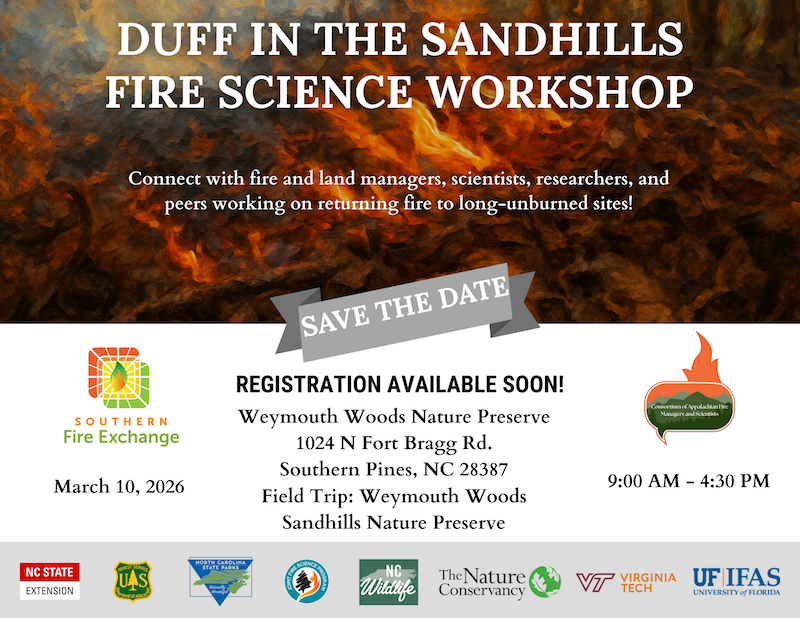
Duff in the Sandhills Fire Science Workshop
Lessons from Fire Science Research and Adaptive Management
March 10, 2026
Weymouth Woods Nature Preserve
The Consortium of Appalachian Fire Managers and Scientists and the Southern Fire Exchange will be hosting a Duff in the Mountains workshop on February 24, 2026. The workshop will be hosted at Weymouth Woods Nature Preserve near Southern Pines, North Carolina. After the morning presentations and discussions, there will be a field tour of several sites at Weymouth Woods.
Description:
Reintroducing fire into long-unburned forests has led to unexpected tree mortality. In many cases, valuable overstory trees, important for wildlife habitat and cultural history, have died following prescribed burns due to large accumulations of soil organic horizons, often referred to as duff. Sites with heavy duff loads continue to present persistent and pressing challenges for prescribed fire managers in the sand hills region of North Carolina. Research funded by the Joint Fire Science Program has revealed that thick layers of dry duff around tree bases ignite and burn slowly, damaging roots, causing stress, and resulting in tree death. These findings shifted fire management strategies toward gradually reducing duff layers rather than immediately restoring open forest structure. This workshop, hosted by Southern Fire Exchange and the Consortium of Appalachian Fire Managers and Scientists, will support this approach by providing scientific presentations, field demonstrations, and planning tools to help land managers assess duff conditions, plan effective burns, and protect legacy and economically important trees. Emphasis will be placed on practical, low-cost techniques, like duff moisture testing and multi-stage burns, making fire science accessible and actionable for a wide range of landowners and fire practitioners.
Purpose:
Connect landowners and fire professionals with the tools, resources, and knowledge to reintroduce prescribed fire to long-unburned areas with significant duff layers.Desired Outcomes
- Increase understanding of duff fire science, including the science that links duff and tree mortality.
- Facilitate conversations between researchers and fire practitioners to inform smoke management in high-duff areas.
- Increase understanding of duff fire management and mitigation practices
- Evaluate specific duff management practices for the montane region