
Cypress Mortality Following Wildfires: Information and Recommendations for Fire and Natural Resource Managers
Adam C. Watts1, Leda N. Kobziar2
1School of Natural Resources and Environment, University of Florida
Publication ID: Fact Sheet 2012-4 Published: 2012 Revised: 2021, 2026
(View PDF)
Fire in Cypress Swamps
Wetlands, most of which rarely experience fire, are often situated adjacent to uplands that burn frequently (as often as every 2-3 years, in some areas). Such landscape mosaics of widely divergent fire frequencies occur extensively across the Southeastern U.S. Coastal Plain, with fireprone longleaf pine (Pinus palustris) savannas or slash pine (P. elliottii) forests in close proximity to forested wetlands, such as swamps dominated by pondcypress (Taxodium distichum var. imbricarium) or baldcypress (T. distichum var. distichum). While wetlands burn less frequently than neighboring upland communities, fire may be second only to hydrology in its long-term influence on species composition and structure (Duever, 1984). The widespread occurrence and ecological value of wetlands, along with the recent occurrence of large wildfires in areas with swamps and wetlands, emphasize the importance of information on the role and effects of fire in cypress swamps for natural resource managers.
Cypress swamps accumulate organic matter in the soil profile in peat-like deposits that may range in depth from only a few inches at wetland edges to several feet near the centers of large, permanently-flooded swamps. Wetland plants display fewer of the adaptations to withstand fire injury seen in many upland plants, making them particularly susceptible to damage from fire. Additionally, roots that occur in the organic layers can be killed or consumed if fire occurs under conditions such as severe drought, when these organic soils may burn as ground fires. This combination of characteristics makes wetland fires likely to produce substantial ecological effects.
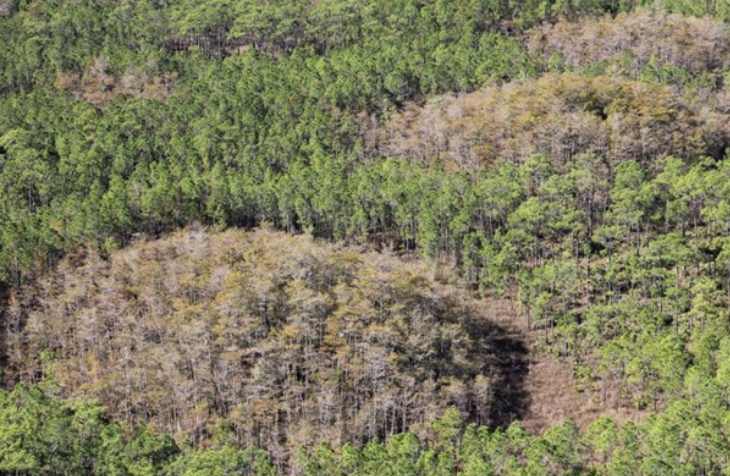
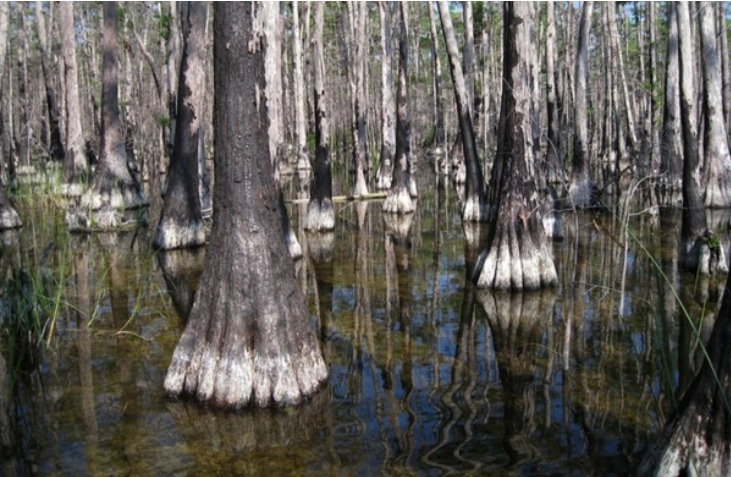
Permanently-flooded cypress swamps, also called “sloughs,” may experience fire once a century or perhaps less often in areas with relatively stable water levels (Snyder, 1991). In contrast, smaller cypress wetlands (Figure 1) experience natural fires more frequently than larger cypress forests, such as elongated “strands” or long-hydroperiod “sloughs” (Wade, Ewel, & Hofstetter, 1980). Low-intensity fires may burn through surface fuels of small swamps as frequently as every 10-20 years, and droughts may lead to more severe fires—such as those that consume dried peat soils (Figure 2)—as frequently as every few decades.
Fire Effects on Cypress
Regardless of the interval at which it occurs, fire is likely to affect a cypress swamp during the lifetimes of the trees growing within it. Cypress have long been regarded as highly resistant to fire, in comparison with other wetland trees, due to their thick bark (Hare, 1965). Cypress also coppice readily following fire, especially when small. These traits, plus their tolerance to flooding, are proposed reasons for the continued dominance of cypress in swamps over long time spans. A 2011 study on the effects of wildfire on cypress mortality (Watts, Kobziar, & Snyder, 2012) provides new information about traits that influence cypress mortality or survival after a wildfire.
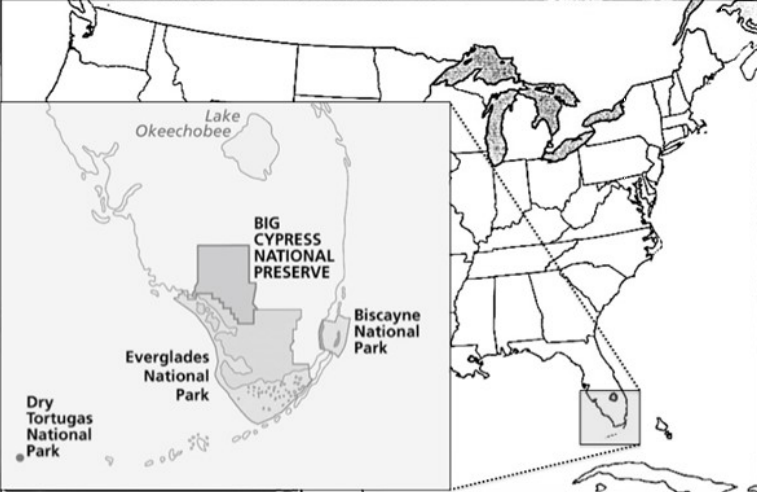
The study began after the 2009 Deep Fire in Big Cypress National Preserve, in extreme southwestern Florida (Figure 3). Pondcypress mortality was monitored for two years after the 30,000-acre fire in 25 small cypress swamps/domes. Fire severity in domes ranged from moderate to high, as measured by the ground-based component of the Composite Burn Index method developed by federal researchers (Key & Benson, 2006). Surprisingly, over 99% of pondcypress recovered their leaves in the weeks following the fire. However, within 12 months after the fire nearly a quarter (23.5%) of the cypress trees had died. This delayed mortality response allowed researchers to assess which factors predict survival or death in response to severe wildfire in cypress domes. In the second year of the census, only an additional 1% of surviving trees died, indicating the bulk of post-fire mortality occurred within one year following the fire.
The study indicated two factors that predict mortality among pondcypress. The first, as expected based on previous studies (Hare, 1965; Ewel & Mitsch, 1978), was size. Smaller trees are far more likely to be killed by fires than larger trees. Bark tends to be thicker in older trees, which also hold their canopies higher above flames than smaller trees. A related finding from the study was that while water certainly plays a role in shaping the structure of cypress forest canopies, fire maintains or exaggerates the tendency of trees to become taller as one proceeds toward the center of a dome or strand (Figure 1). The apparent mechanism for this exaggeration of the characteristic dome-shaped profile of small cypress swamps is topkill of smaller trees, which occur closer to the edges of swamps, and greater survival among the larger sizes of trees that occur in swamp interiors.
A second factor related to mortality was the site elevation, which is related to hydroperiod—the number of days per year that a given location is inundated. This factor appeared to play as great a role in determining cypress survival as did tree size. Trees occurring in areas where slightly lower soil elevations (as little as a few inches difference) resulted in longer hydroperiods were more likely to die in the year following the Deep Fire than their higher-elevation peers. The mechanisms to explain this interesting result have not yet been researched, but may include an increased presence of vulnerable fine roots in the upper soil layers where lower soil elevations create anoxic conditions deeper in the soil profile. Such roots, if present, might be more susceptible to damage during smoldering ground fires when organic soils are dry.
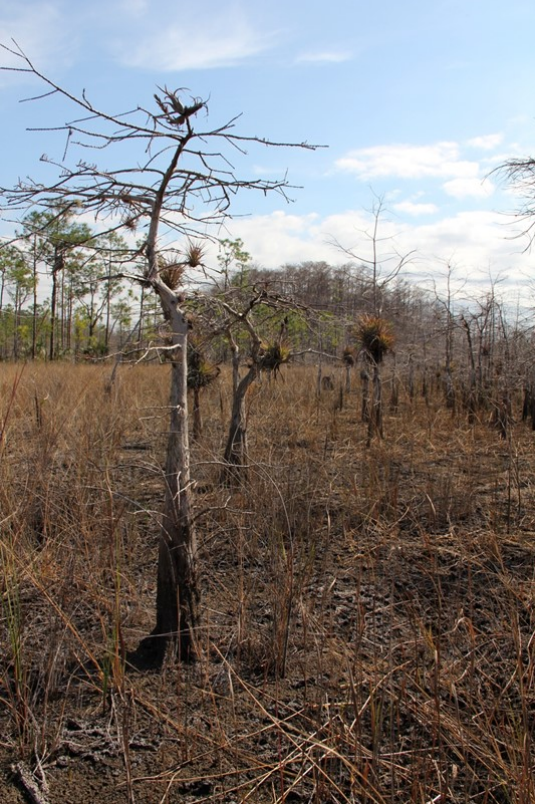
In addition to being more likely to die following fires, smaller cypress trees that did survive the fire were often topkilled, sprouting back from stunted stems. Over time, pondcypress that are burned repeatedly attain gnarled forms and are called “hatrack” or “bonsai” cypress (Figure 4). This response is typical for many trees and shrubs, but indicates that in some areas where management goals include the reduction of cypress encroachment (marl prairies, for example) fire may be as effective a management tool for controlling cypress spread as it is for reducing woody species in uplands. Even if such goals are not part of the management paradigm, this effect’s repercussions for the magnitude of cypress influence on dome-prairie ecotones remains relevant.
Conclusion
Managers face multiple challenges when confronted with landscapes where fire can occasionally enter cypress swamps. Often, these wetlands are used as natural fire breaks, particularly during prescribed burns; in most cases when conditions are conducive to burning, swamps will be too moist for fires to burn into them. However, like any forest, swamps accumulate biomass that can become available fuel under the right circumstances. Fire management strategies that completely restrict the spread of fire into swamps may produce problems similar to those that stem from fire suppression in uplands, such as the potential for higher severity wildfires during severe droughts. Enhanced fuel loads due to fire suppression may increase the chances of problematic ground fires, or of excessive tree mortality. While cypress swamps should not necessarily be treated as targets of prescribed burns, managers might allow low-intensity fires to occasionally enter swamps under conditions of low water to achieve fuel reduction benefits, if residual smoke and ground fires will not be an issue. Under drought conditions, the potential for tree mortality should be carefully considered.
References Cited
- Duever M. J. (1984). Environmental factors controlling plant communities of the Big Cypress Swamp. In P. J. Gleason (Ed.), Environments of south Florida: present and past II (pp. 127–137). Coral Gables, FL: Miami Geological Society.
- Ewel, K. C. & Mitsch, W. J. (1978). The effects of fire on species composition in cypress dome ecosystems. Florida Scientist 41(1), 25–31. url: https://www.jstor.org/stable/24319515.
- Hare R. C. (1965). Contribution of bark to fire resistance of Southern Trees. Journal of Forestry 63, 248–251. doi: 10.1093/jof/63.4.248.
- Key C. H. & Benson N. C. (2006). Landscape assessment: ground measure of severity, the Normalized Burn Index. In D. C. Lutes, R. E. Keane, J. F. Caratti, C. H. Key, N. C. Benson, S. Sutherland, & L. J. Gangi (Eds.), FIREMON: Fire effects monitoring and inventory system (pp. 1–51) (General Technical Report RMRS-GTR-164-CD). Fort Collins, CO: US Department of Agriculture, Forest Service, Rocky Mountain Research Station. url: https://www.fs.fed.us/rm/pubs/rmrs_gtr164/rmrs_gtr164_13_land_assess.pdf.
- Snyder J. R. (1991). Fire regimes in subtropical south Florida. In S. I. Cerulean & R. T. Engstrom (Eds.), High intensity fire in wildlands: Management challenges and options (pp. 111–116). Proceedings of the Tall Timbers Fire Ecology Conference Number 17. Tallahassee, FL: Tall Timbers Research Station. url: https://talltimbers.org/wp-content/uploads/2018/09/303-Snyder1991_op.pdf.
- Wade D. J., Ewel J. J., & Hofstetter R. (1980). Fire in South Florida Ecosystems (General Technical Report SE-17). Asheville, NC: US Department of Agriculture, Forest Service, Southeastern Forest Experiment Station.
- Watts A. C., Kobziar L. N., & Snyder J. R. (2012). Fire reinforces structure of pondcypress (Taxodium distichum var. imbricarium) domes in a wetland landscape. Wetlands 32, 439–448. doi: 10.1007/s13157-012-0277-9.