
Mechanical Treatments in Pine Flatwoods: A Temporary Rearrangement of Fuel Structure
Jesse Kreye1, David Godwin2, Leda Kobziar2
1Mississippi State University
2Southern Fire Exchange
Publication ID: Fact Sheet 2015-1 Published: 2015 Revised: 2021, 2026
(View PDF)
Mechanical Fuel Treatments
Prescribed burning is a dominant forest management tool used across the Southeastern U.S., yet burning is often limited due to various social, ecological, or economic factors. The use of mechanical methods as a fire surrogate or as a means to treat overgrown fuels prior to reintroducing fire has become increasingly used in the region, especially in the wildland-urban-interface (WUI) and other areas with significant smoke concerns. Mechanical treatments can include thinning of the overstory, treating understory shrubs and small trees, or a combination of both. Understory treatments commonly used in the South include “mowing”, “mulching”, “masticating” or “chipping” (depending on the equipment used) of shrubs and small trees. While different terms are used, each treatment is aimed at transforming aerial fuels to surface fuels to reduce fire behavior. Treatments are often employed as a stand-alone option in the WUI, or are followed-up with prescribed burning where possible. While specific treatment objectives may vary, reduction of potential fire behavior attributes including flame lengths, rate of spread, and crown fire potential, are emphasized. Reducing these fire behavior factors is important to both follow-up prescribed burning and potential wildfire.
Summary
Mechanical “mowing” treatments can alter the structure and arrangement of understory and midstory fuels in pine flatwoods thereby reducing post-treatment flame lengths and rates of fire spread. Shrubs, however, can quickly recover following treatment and reduce the longevity of this effectiveness. Surface fuels resulting from the mowing of small trees and shrubs may present challenges given that long-duration combustion can occur in these compact fuels. The timing of subsequent mechanical or prescribed fire treatments may be very important for achieving management objectives.
Treatment of Fuels in Pine Flatwoods
Mowing is a common mechanical fuels treatment method especially in long-unburned pine flatwoods (ca. >10 yr. old rough) of the Southeastern Coastal Plain, where understories are dominated by saw palmetto (Serenoa repens) and gallberry (Ilex glabra) shrubs. Although understory shrubs in these stands can be very dense, mature longleaf pine (Pinus palustris) and slash pine (P. elliottii) in the overstory are often sufficiently spaced to facilitate mowing without damage to mature trees. While shrubs are typically the target of mowing in flatwoods, understory and midstory hardwoods may also be targeted in forests that have gone without fire for longer durations.
Importantly, mowing itself is not a “fuels reduction” treatment as it doesn’t actually reduce fuel loads, but rather alters or rearranges fuel structure. During treatment, shrubs and small trees are shredded and spread across the forest floor creating a dense and shallow fuel bed (usually ≤ 4 inches deep, with the depth depending on the quantity of vegetation mowed).
Following treatment, fuel bed height is greatly reduced while fuel bed bulk density is substantially increased, both of which can influence fire behavior1. Fuel beds created from mowing are mixtures of small-diameter woody fuels composed of broken sticks from shrub stems, or fractured (shredded) woody debris from larger shrub or tree stems. In pine flatwoods, the bulk of the post-mowing forest floor material is often composed of shredded saw palmetto foliar material2. These pine flatwoods post-treatment fuel beds can be somewhat “fluffy” or aerated compared to mowed debris generated in forests where woody shrubs or trees dominate the understory3. Although the surface of such fuel beds may initially appear “fluffy,” the lower strata of mowed fuels remain relatively dense and may become more compact overtime.
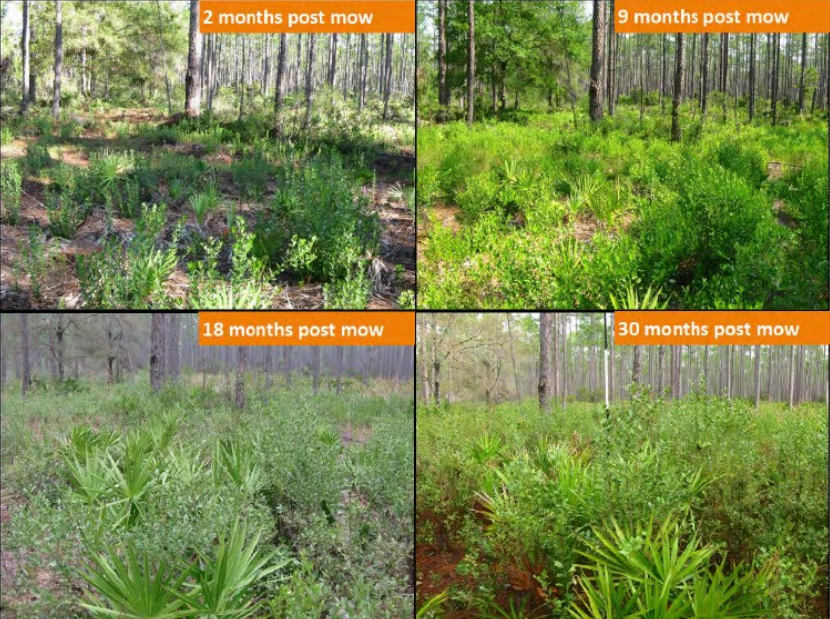
Although shrubs are converted to dense surface fuels by mowing, they recover quickly following treatment in pine flatwoods1. It is unclear how mowing impacts shrub or tree regeneration from seeds, but palmetto, gallberry and many other flatwoods shrub species sprout vigorously after a disturbance. Where the rate of shrub regrowth exceeds that of decomposition of mowed surface fuels, total fuel loads may actually increase following mowing treatments. Timing post-treatment application of prescribed fire or subsequent mowing treatments may be critical to achieving management objectives.
Effects Following Treatments
Mowing of palmetto and gallberry understories in pine flatwoods may reduce flame lengths and rate of spread because shrubs are converted to dense surface fuels. However, the effectiveness of fire behavior reduction may be short-lived since shrubs recover quickly in these ecosystems. While mowed fuels may drive fire behavior immediately (within months) following treatment, shrub regrowth may lead to increases in flame length and rate of spread within a year following treatment. When post-mowing surface fuels from these treatments are ignited, research has shown that their increased bulk density can result in longer residence time, and concentrated heating of the forest floor4. In some cases, this prolonged heating can result in duff ignition and, if substantial fine root structures occupy the duff, overstory tree mortality.
Management Recommendations
Using mowing treatments to alter potential fire behavior is a plausible management option, but the timing of treatments is critical to meeting management objectives. As a stand-alone treatment, mowing is likely to reduce flame length soon after treatment, but where shrub recovery is rapid, treatments would need to be frequently implemented to maintain low shrub densities and heights1. The accumulation of surface fuels from frequent mowing would likely pose a hazard to residual trees because of the potential for subsequent wildfires to result in long-duration heating of the forest floor and soils. These factors need to be considered when evaluating the use of mowing treatments to meet specific management objectives, especially in the WUI. When used in conjunction with prescribed burning, pine flatwoods mowing treatments are best applied where follow-up burning is expedient, in order to consume surface fuels prior to shrub recovery. Post-mowing prescribed fires should be timed to coincide with fuel moisture conditions that support the reduction of surface fuels, while minimizing the potential for duff ignition and subsequent overstory mortality.
Additional Resources
- Budney, M.L., Kreye, J.K., Kobziar, L.N., Camp, J.M. 2013. Fuel Treatments in Pine Flatwoods: A Photo Series Guide. Tech. Rep. Gainesville, FL: University of Florida School of Forest Resources and Conservation. Available at https://southernfireexchange.org/wp-content/uploads/Fuel_Treatments_Photo_Guide.pdf.
- Kreye, J.K., Kobziar, L.N., Camp, J.M. 2014. Immediate and short-term response of understory fuels following mechanical mastication in a pine flatwoods site of Florida, USA. Forest Ecology and Management 313: 340-354.
- Kreye, J.K., Brewer, N.W., Morgan P., Varner, J.M., Smith, A.M.S., Hoffman, C.M., Ottmar, R.D. 2014. Fire behavior in masticated fuels: A review. Forest Ecology and Management 314: 193-207.
- Kreye, J.K., Kobziar, L.N., Zipperer, W.C. 2013. Effects of fuel load and moisture content on fire behavior and heating in masticated litter-dominated fuels. International Journal of Wildland Fire 22: 440-445.
- Kreye, J.K., Kobziar, L.N. 2015. The effect of mastication on surface fire behavior, fuels consumption and tree mortality in pine flatwoods of Florida, USA. Journal of Wildland Fire doi: 10.1071/WF14186.
- Menges, E. and D. Gordon. 2010. Should mechanical treatments and herbicides be used as fire surrogates to manage Florida’s uplands? A review. Florida Scientist 73: 147- 174.
- O’Brien, J., Mordecai, K.A., Wolcott, L. 2010. Fire managers field guide: hazardous fuels management in subtropical pine flatwoods and tropical pine rocklands. Gen. Tech. Rep. SRS-123. Asheville, NC: U.S. Department of Agriculture Forest Service, Southern Research Station Available at http://www.treesearch.fs.fed.us/pubs/35520.