
What the Research Says: Prescribed Fire and Wildfire Risk Reduction
Alan Long1, Annie Oxarart2
1Tall Timbers Research Station
2University of Florida
Publication ID: Fact Sheet 2017-1 Published: 2017 Revised: 2026
(View PDF)
A variety of research studies have found similar conclusions: Prescribed fire reduces wildfire risk, intensity, and size in southern pine flatwoods ecosystems, but for a relatively short time.
Most fire and natural resource managers across the Southeast agree that prescribed fire reduces wildfire risk. After all, fuels reduction is an objective that is often included in burn plans, and many managers and landowners have seen firsthand how wildfires respond in unburned versus frequently burned areas. But beyond observational and anecdotal information, what scientific findings do we have that prescribed fire reduces wildfire risk? And how long do these effects last? These questions have been asked for at least 50 years in the South and a number of research studies have addressed them from various angles. This fact sheet summarizes the conclusions of five studies conducted in pine flatwoods ecosystems.
One of the earliest studies that assessed prescribed fire effects on wildfire risk was reported by Davis and Cooper (1963). The authors tracked 380 wildfires over 4 years on almost 1 million acres in South Georgia and North Florida and classified the years since the last burn for each wildfire. Results of this study showed that the areas classified as having a 0‒2 year rough had a wildfire occurrence rate of 0.73 wildfires per 10,000 acres, while the 3‒5 year rough had a rate of 1.19 wildfires per 10,000 acres. In addition, the acres burned annually increased with the time since fire, with annual burn percentages ranging from 0.03% to 0.14% in the 0‒5 year rough and 7.2% in the more than 5 year rough.
Conclusion: Fuel accumulations of fewer than 3 years resulted in less wildfires, fewer acres burned, and lower fire intensities than fuel accumulations greater than 3 years.
From 1998 to 2000, wildfires occurred across northern Florida, with several of those fires burning up to or across areas that had been treated with prescribed fire or other fuel treatments. This provided an opportunity for researchers to evaluate the effects of fuels treatments on wildfire characteristics. For example, Brose and Wade (2002) measured fuel loads in Northeast Florida on sites where fuels had been treated through herbicide application, prescribed fire, or thinning. Fuel loads were measured 1, 2, 3, or 4 years after treatment, and the treatments were compared with unburned rough. The fuel load measurements were then used, in combination with weather conditions recorded during the 1998 wildfires, to evaluate fire behavior in the BEHAVE fire modeling system. Using flame length and rate of spread results as indicators to predict difficulty of wildfire control, the study found that “fire behavior in the 1-year-old prescribed burn and thinned stands would be mild, allowing for easy control” while the opposite is true for untreated stands and for 1-year-old herbicide stands.
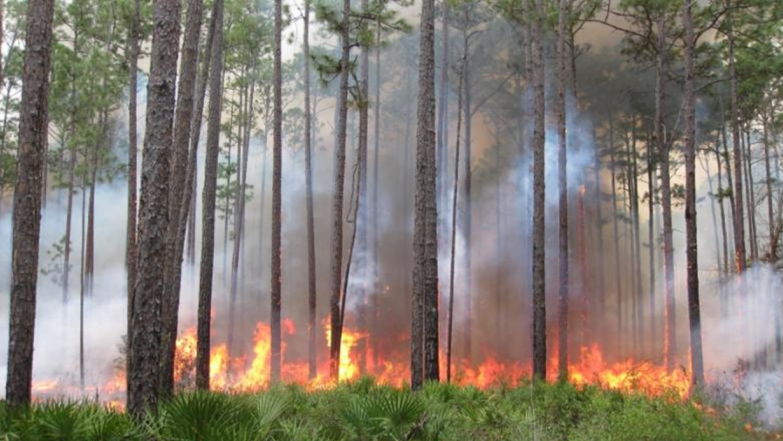
Conclusion: Based on model predictions, prescribed fire reduces wildfire hazard for approximately 1 to 2 years, until shrubs recover.
In another study, Outcalt and Wade (2004) evaluated pine mortality after the 1998 and 2000 Florida wildfires on three different properties in Northeast Florida that represented a range of prescribed burning regimes. Results from stands in the Osceola National Forest showed that pine mortality was lowest after wildfires in stands burned in the previous 1.5 years, as compared to older roughs. In addition, the results showed that pine mortality was higher at Tiger Bay State Forest, where prescribed burning had been used less frequently, and was highest at Lake Butler forest where prescribed fire was not used.
Conclusion: Wildfire intensity and severity were lower on sites one to two years after prescribed fire than on sites with longer fire return intervals.
A more recent study used Landsat satellite imagery of 217 fires (101 prescribed fires and 116 wildfires) that occurred from 1998 to 2008 on the Osceola National Forest in northeast Florida to detect differences in fire severity as related to previous fire history (Malone, Kobziar, Staudhammer, & Abd-Elrahman, 2011). Images from before each fire and one year after each fire were assessed to determine fire severity levels and then analyzed through statistical models to determine changes in severity level based on time since previous fire. Results showed that the probability of high burn severity increased with time since previous fire, up to 5‒6 years. In addition, areas that had not been burned in 5‒6 years had the highest probability of burning, a result somewhat analogous to Davis and Cooper’s observations in 1963. The time period of 5-6 years “emerged as the point where previous fires had limited mitigating effects on subsequent fires.”
Conclusion: The lowest probability of high severity wildfires were in areas that had been burned in the previous one to two years.
Results from a long-term study at Fort Benning, Georgia support the conclusions above that prescribed fire decreases probability of wildfire (Addington et al., 2015). The study used 30 years of wildfire, prescribed fire, and weather records to answer two questions: Are wildfire incidence and area related to prescribed fire activity? And how is that relationship influenced by drought? The results demonstrated a strong trend between an increase in annual prescribed fire acreage over the 30-year period and a decrease in the number of wildfires. The trend in wildfire-burned acres was more variable, partly as a result of drought (measured as annual average KBDI), along with other factors unaccounted for in the models, such as suppression tactics, fuels, and topography. In years with the least prescribed fire acres and drought conditions, wildfire incidence increased substantially.
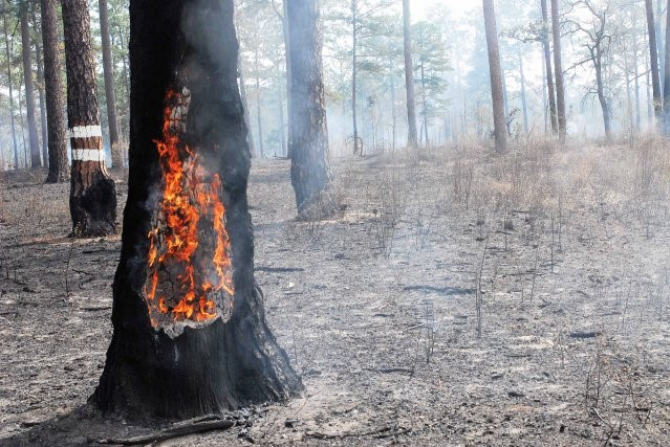
Conclusion: The strongest explanation for fewer wildfires included prescribed fire acres for both the current and previous year, previous wildfire incidence, and drought.
Summary
Collectively, these studies indicate that 50 years of research have found similar results: In flatwoods ecosystems in the South, prescribed burning reduces wildfire risk for several years after the burn until the shrub understory and midstory recover. While Davis and Cooper’s 1963 research is still supported, additional research in the last two decades has refined the fire risk reduction time interval to approximately two years following a prescribed fire.
Interestingly, 500 fire practitioners in 12 southern states responded to an online survey regarding prescribed fire effectiveness with the same overall conclusion based on their personal experience (Kobziar, Godwin, Taylor, & Watts, 2015). Managers consistently reported that a 1‒2 year fire interval was effective at decreasing wildfire ignitions, behavior, and severity, while a 3‒4 year fire interval was not viewed as effective. The length of perceived effectiveness was strongly correlated to the respondents’ perception of the historical fire return interval for different vegetation communities.
References
- Addington, R. N., Hudson, S. J., Hiers, J. K., Hurteau, M. D., Hutcherson, T. F., Matusick, G., & Parker, J. M. (2015). Relationships among wildfire, prescribed fire, and drought in a fire-prone landscape in the southeastern United States. International Journal of Wildland Fire, 24, 778‒783.
- Brose, P., & Wade, D. (2002). Potential fire behavior in pine flatwood forests following three different fuel reduction techniques. Forest Ecology and Management, 163, 71‒84. Available at www.treesearch.fs.fed.us/pubs/4443.
- Davis, L. S., & Cooper, R. W. (1963). How prescribed burning affects wildfire occurrence. Journal of Forestry, 61, 915‒917.
- Kobziar, L. N., Godwin, D., Taylor, L., & Watts, A. C. (2015). Perspectives on trends, effectiveness, and impediments to prescribed burning in the southern U.S. Forests 6(3), 561‒580. Available at www.mdpi.com/1999-4907/6/3/561/htm.
- Malone, S. L., Kobziar, L. N., Staudhammer, C. L., & Abd-Elrahman, A. (2011). Modeling relationships among 217 fires using remote sensing of burn severity in southern pine forests. Remote Sensing, 3(9), 2005‒2028. Available at www.fs.fed.us/rm/pubs_journals/2011/rmrs_2011_malone_s001.pdf.
- Outcalt, K. W., & Wade, D. D. (2004). Fuels management reduces tree mortality from wildfires in southeastern United States. Southern Journal of Applied Forestry, 28(1), 28‒34. Available at www.treesearch.fs.fed.us/pubs/6275.