
Using Fire to Manage for Oak Regeneration in Eastern and Southeastern U.S. Oak-Hardwood Ecosystems
1University of Florida
Artwork by: Arti Chequer
Publication ID: Fact Sheet 2022-2 Published: 2022 Revised: 2026
(View PDF)
Introduction
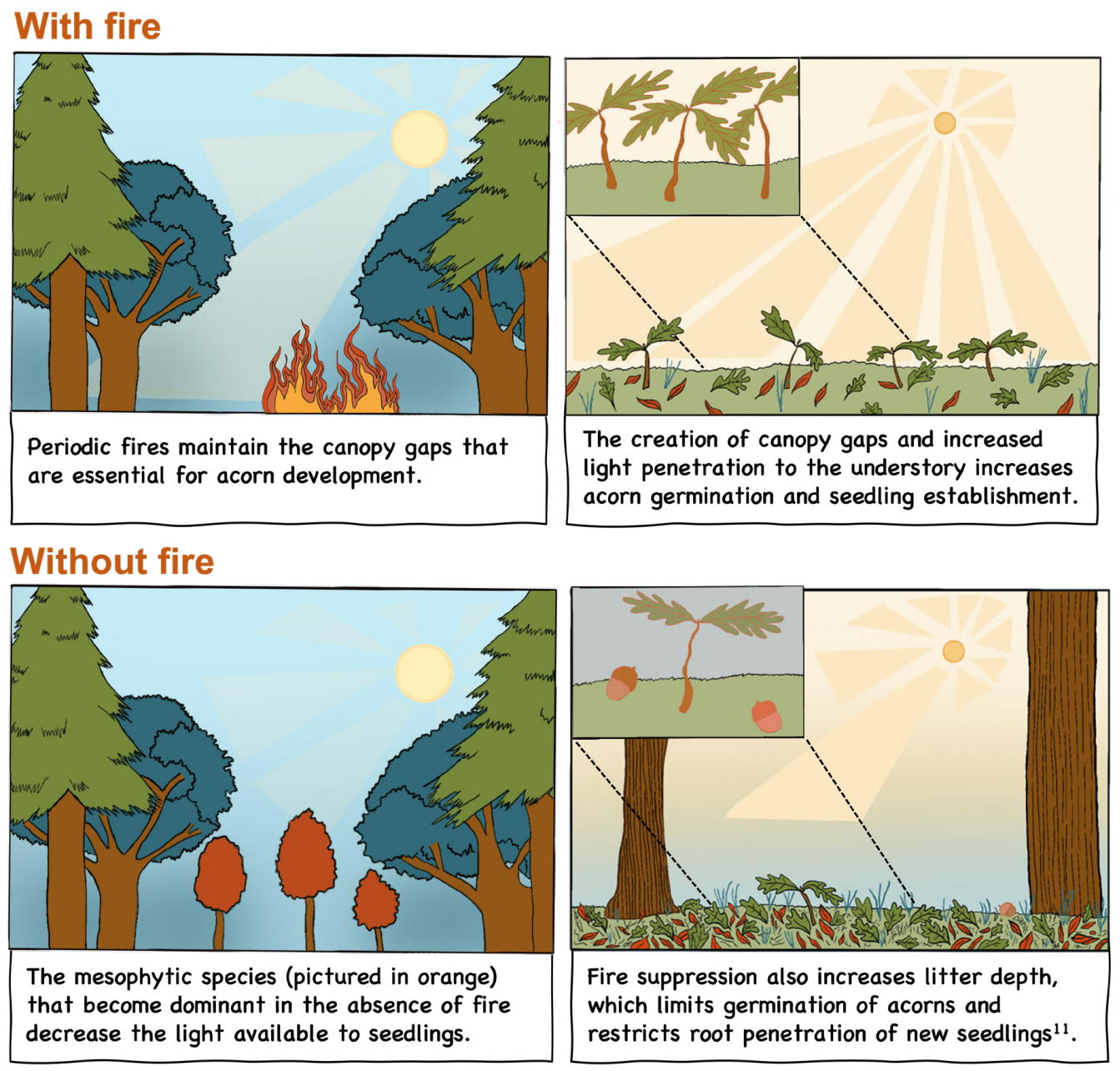
A regime of periodic, low-intensity fire is considered to have historically maintained upland oak-hardwood ecosystems in the eastern United States. These ecosystems were once widespread in uplands from southern New England to the central and southern Appalachians and Piedmont, westward to the edges of the Great Plains.1 Fire promotes the value of oak-hardwood ecosystems as wildlife habitat and centers of herbaceous plant diversity by maintaining an open, well-lit understory. Fire suppression and potentially other factors such as climate changes and herbivory2 can cause oak-dominated land types to be replaced by shade tolerant species such as red maple (Acer rubrum), green ash (Fraxinus pennsylvanica), and black gum (Nyssa sylvatica). This process, called mesophication, is a major barrier to oak restoration. Mesophication results from a closed canopy of such shade tolerant species, which promotes an accumulation of moist, leaf litter3 that can alter soil moisture and temperature regimes,2 inhibiting fire ignition and spread. These conditions are linked to widespread oak regeneration failure.2,4,5 Prescribed fire, often in conjunction with other management practices such as thinning, can be used to restore upland oak ecosystems by promoting environmental conditions favorable to oak acorn germination, seedling survival, and recruitment into the canopy.
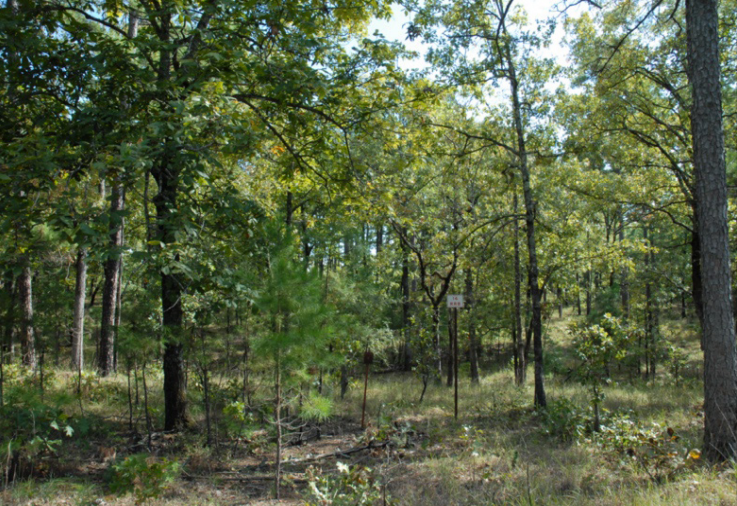
Upland oak-hardwood ecosystems are generally found on elevated terrain, such as slopes and bluffs. They are primarily composed of oak species in the overstory and a variety of low-growing shrubs in the understory. The degree of canopy closure in these ecosystems varies throughout their range from north to south, depending on the dominant canopy species. Ecosystems with regular fire have a more open canopy, which increases the sunlight that favors a diversity of plant species in the understory. The photo to the left was taken in an experimental unit that has been burned every four years for more than 30 years.
Life Histories of Oaks and Their 'Competitors'
Effects of Fire on Oaks During Different Life Stages
Management Guidelines
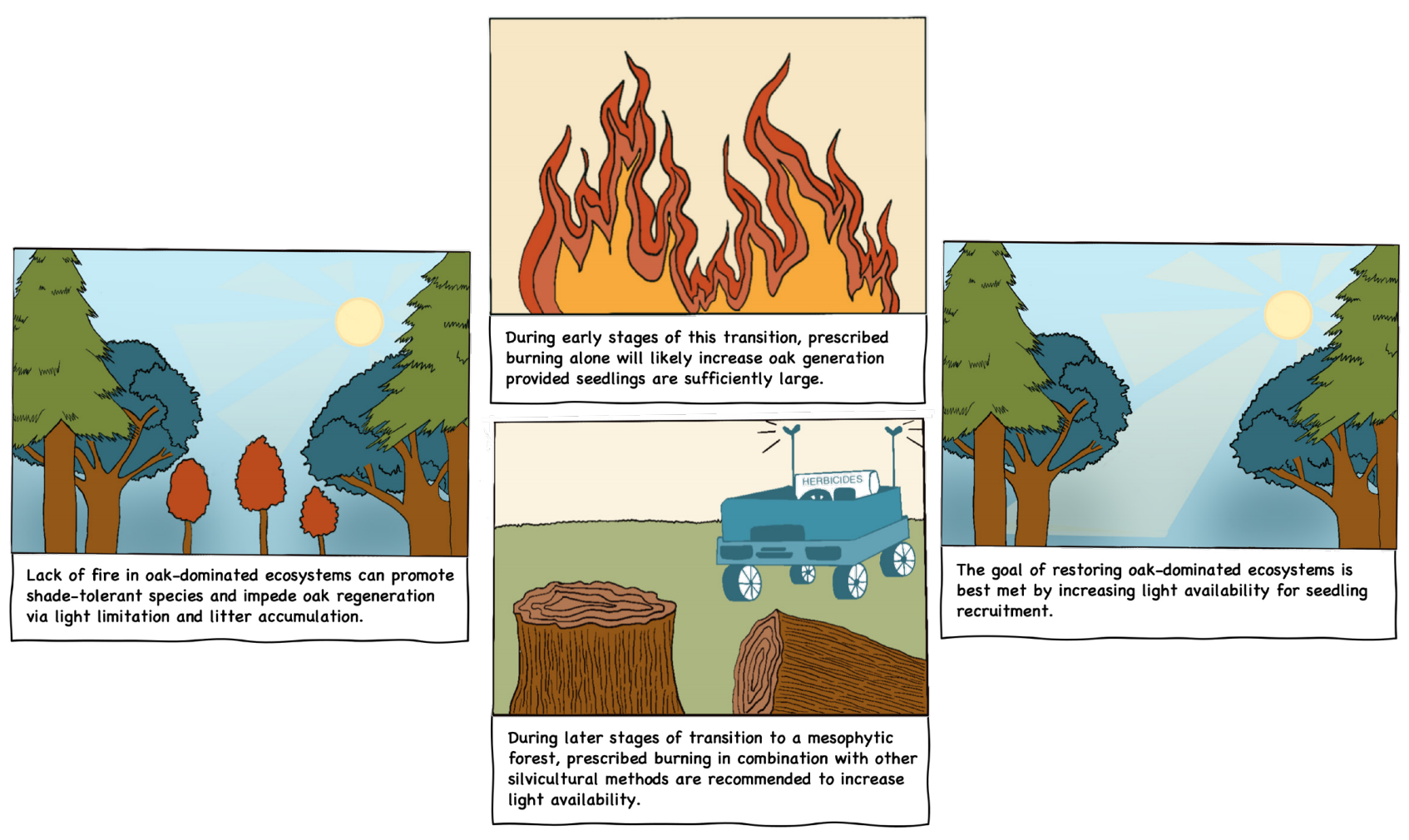
Judicious use of fire can increase and maintain the value of oak trees throughout restoration.13 As with any restoration project, it is important to evaluate site conditions before burning.11 Effective application of prescribed fire depends on amount of existing oak regeneration, management objectives, unit size, composition, fuel loading, and past management regime. For example, in mature oak stands with few oak recruits, fire might be used to reduce competing species’ density in the understory, increase light availability,14 and reduce litter depth to promote acorn germination and establishment.12 These “seedbed preparation burns” are often limited by lack of fine fuels. Burns should be frequent, but still allow some fuel accumulation between burns. Oak reproduction is often sporadic, however, and thus the time to restoration could take a decade or more.6 Burning during the growing season when the midstory is more vulnerable, and using herbicides, can hasten the process.15 Fire can also be used to release existing oak regeneration into the canopy.16
“Release burning” is used in cases where abundant oaks that are two feet tall or 0.5 inches in diameter are competing with more numerous mesophytic species.14 The effectiveness of prescribed burning during different seasons for achieving mortality-related objectives varies.17 Although growing season burns have typically been considered most effective, they should be used cautiously as small, suppressed oak seedlings can be killed.
Because adult trees are generally resistant to fires, prescribed burning is recommended in combination with other silvicultural methods like regeneration cutting or mechanical thinning to reduce undesired tree species density and to open the canopy.11 This increasing light availability promotes oak regeneration but might also require the application of prescribed fire by increasing the drying of non-flammable mesophytic litter.2 Once oaks are dominant, periodic fires (2-5 fires spread over a decade) should benefit oak survival and regeneration by maintaining relatively high understory light availability and reducing competing species.17
Some managers are concerned that burning oak-hardwood ecosystems will damage timber and reduce value. Research has shown that there is a trade-off with an overall economic benefit of prescribed burning.18 Although there might be some damage to trees, which reduces timber values, there is a disproportionately larger economic benefit of natural oak regeneration.8,18 This saves the money that would otherwise be required to manually replant trees after harvesting. In addition to a net economic gain, the probability of wildfire is reduced, and many ecosystem services are improved by managing oak-hardwood ecosystems with frequent, low intensity prescribed fires.
Conclusions
References
- Dey, D.C., Brissette, J.C., Schweitzer, C.J., and Guldin, J.M. 2012. The silviculture of forests in the Eastern United States. Pp. 7-40 in LaFayette, R., Brooks, M.T., Potyondy, J.P., Audin, L., Krieger, S.L., and Trettin, C.C. (Eds.) Cumulative watershed effects of fuel management in the Eastern United States. USDA Southern Research Station General Technical Report SRS-161. Asheville, NC.
- Alexander, H.D., Siegert, C., Brewer, J.S., Kreye, J., Lashley, M.A., McDaniel, J.K., Paulson, A.K., Renninger, H.J., and Varner, J.M., 2021. Mesophication of Oak Landscapes: Evidence, Knowledge Gaps, and Future Research. BioScience 71: 531-542.
- Babl, E., Alexander, H.D., Siegert, C.M., and Willis, J.L. 2020. Could canopy, bark, and leaf litter traits of encroaching non-oak species influence future flammability of upland oak forests? Forest Ecology and Management
458: 117731. - Alexander, H.D., Arthur, M.A., Loftis, D.L., and Green, A.R., 2008. Survival and growth of upland oak and co-occurring competitor seedlings following single and repeated prescribed fires. Forest Ecology and Management 265: 1021-1030.
- McDaniel, J.K., Alexander, H.D., Siegert, C.M., and Lashley, M.A. 2021. Shifting tree species composition of upland oak forests alters leaf litter structure, moisture, and flammability. Forest Ecology and Management 482: 118860.
- Brose, P.H., Dey, D.C. and Waldrop, T.A., 2014. The fire—oak literature of eastern North America: synthesis and guidelines. Gen. Tech. Rep. NRS-135. Newtown Square, PA: U.S. Department of Agriculture, Forest Service, Northern Research Station. 135: 1-98.
- Dey, D.C., Guyette, R.P., Schweitzer, C.J., Stambaugh, M.C. and Kabrick, J.M., 2015. Restoring oak forest, woodlands and savannas using modern silvicultural analogs to historic cultural fire regimes. In: Proceedings of the second international congress of silviculture. 2014 November 26-29; Florence, Italy. Florence, Italy: Accademia Italiana di Scienze Forestali: 116-122.
- Dey, D., and Schweitzer, C., 2018. A review on the dynamics of prescribed fire, tree mortality, and injury in managing oak natural communities to minimize economic loss in North America. Forests 9: 461.
- Izbicki, B. J., Alexander, H. D., Paulson, A. K., Frey, B. R., McEwan, R. W., & Berry, A. I. (2020). Prescribed fire and natural canopy gap disturbances: Impacts on upland oak regeneration. Forest Ecology and Management 465: 118107.
- Arthur, M.A., Paratley, R.D., and Blankenship, B.A. 1998. Single and repeated fires affect survival and regeneration of woody and herbaceous species in an oak-pine forest. Journal of the Torrey Botanical Society 125: 225-236.
- Arthur, M.A., Alexander, H.D., Dey, D.C., Schweitzer, C.J. and Loftis, D.L., 2012. Refining the oak-fire hypothesis for management of oak-dominated forests of the eastern United States. Journal of Forestry 110: 257-266.
- Nation, R.E., Alexander, H.D., Denny, G., McDaniel, J.K., and Paulson, A.K. 2021. Impacts of increasing fine fuel loads on acorn germination and early growth of oak seedlings. Fire Ecology 17: 1-13.
- Dey, D.C., Stambaugh, M.C., and Schweitzer, C.J. 2021. Learning to live with fire: managing the impacts of prescribed burning on eastern hardwood value. Fire Management Today 79: 52-60.
- Brose, P.H., 2014. Development of prescribed fire as a silvicultural tool for the upland oak forests of the eastern United States. Journal of Forestry 112: 525-533.
- Brose, P.H., Dey, D.C., Phillips, R.J. and Waldrop, T.A., 2012. A meta-analysis of the fire-oak hypothesis: does prescribed burning promote oak reproduction in eastern North America? Forest Science 59: 322-334.
- Brose, P.H., Dey, D.C., Phillips, R.J. and Waldrop, T.A. Restoring and sustaining eastern oak forests with prescribed fire. Final Report of Project 10-2-01-1. https://www.firescience.gov/projects/10-2-01-1/project/10-2-01-1_final_report.pdf
- Vander Yacht, A.L., Keyser, P.D., Barrioz, S.A., Kwit, C., Stambaugh, M.C., Clatterbuck, W.K., and Simon, D.M. 2019. Reversing mesophication effects on understory woody vegetation in mid-southern oak forests. Forest Science 65: 289-303.
- Mann, D.P., Wiedenbeck, J.K., Dey, D.C., and Saunders, M.R. 2020. Evaluating economic impacts of prescribed fire in the Central Hardwood Region. Journal of Forestry. 118: 275-288.