New Southern Forest Outlook Focused on Fire
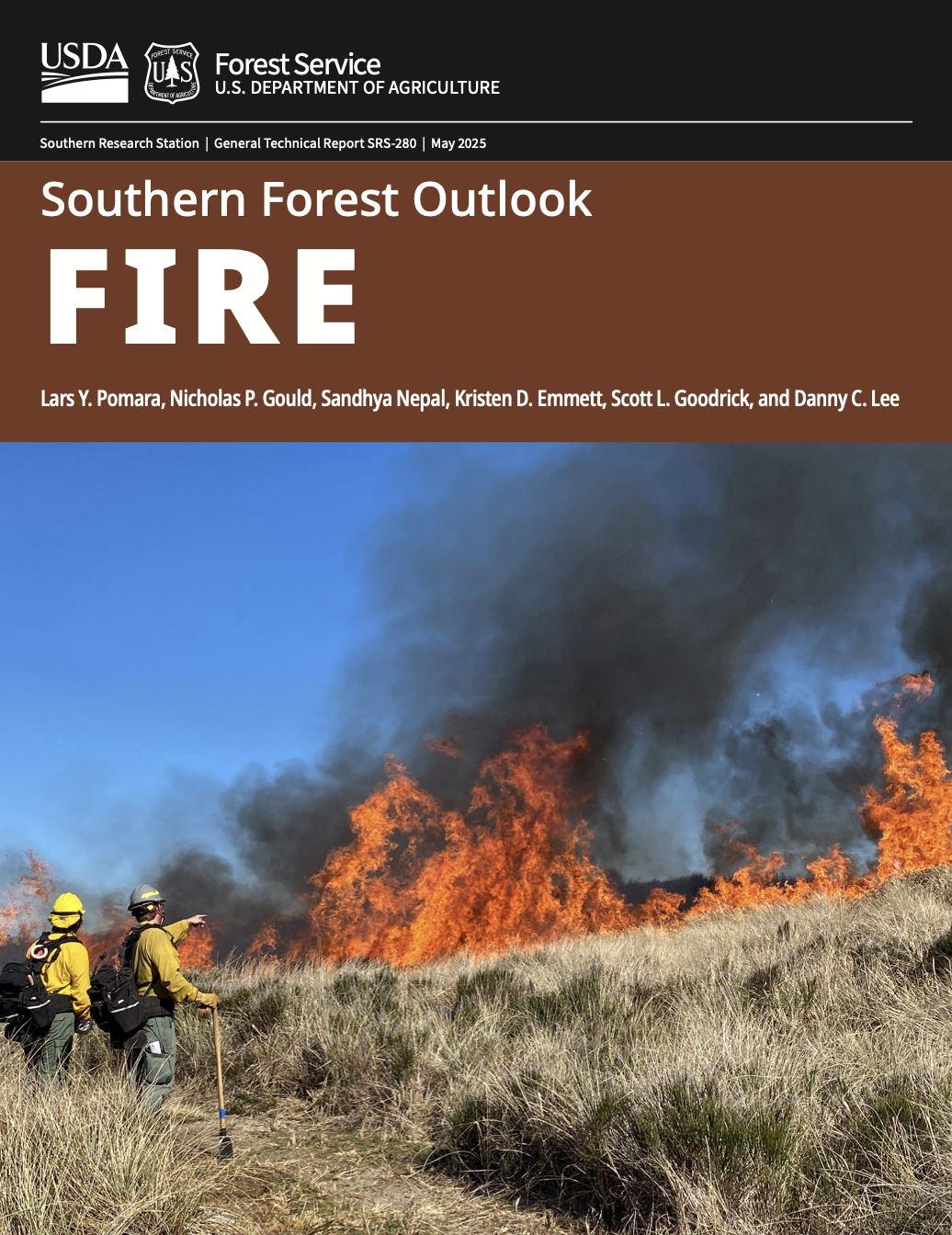
The USDA Forest Service Southern Research team recently released the Southern Forest Outlook Fire report (published 2025). The report is a regional analysis of trends, issues, and the future of wildland fire in the southeast. This report was developed by scientists at the Southern Research Station in partnership with the US Forest Service Region 8 Fire and Aviation Group and the Southeastern Cohesive Wildland Fire Management Strategy.
This document may be a helpful resource for developing active management plans that seek to increase ecosystem resilience and for understanding some of the challenges that forests and ecosystems of the region may face in the future. Download the full report (pdf).
Southern Forest Outlook: Fire (USGS GTR SRS-280)
Written by Lars Pomara, Nicholas Gould, Sandhya Nepal, Kristen Emmett, Scott Goodrick, and Danny Lee, USDA Forest Service Southern Research Station
Abstract
This report in support of the Southern Forest Outlook assesses current and future risks associated with wildfire and smoke in the Southern United States, through a synthesis of literature review and new analysis. Key questions concern wildfire risk management and resilience-building efforts in the face of a changing climate, risks to forest ecosystem services, the potentially disproportionate impacts of fire and smoke on socioeconomically vulnerable populations, and how the growing wildland-urban interface, changes in fire regimes, and changes in safe prescribed burning conditions are likely to impact future management efforts. Results portray the regional geography of wildfire and smoke risks to people and ecosystem services, and where high return on fuel reduction investments can be achieved. Modeled future changes suggest shifts towards forests more prone to hazardous fire, with changes in risks to people and ecosystem services varying geographically and among different future scenarios. Results also suggest that preemptive forest management efforts including prescribed fire can offset future changes in wildfire and smoke risks. Ongoing and future changes in climate, forests, and society present complex wildfire risk challenges, but pathways exist to build forest resilience and mitigate risk.